
Artificial Intelligence (AI) has transcended its early development stages and is now a transformative force that is reshaping industries around the world. From streamlining manufacturing processes and improving patient outcomes in healthcare to revolutionizing the way we manage finances and transportation, AI is driving innovation and operational efficiency. As automation becomes more prevalent, discover how AI Is Revolutionizing Industries through automation, improving efficiency, productivity, decision-making, and future business operations. This blog delves into the profound impact of AI on various sectors and its crucial role in the future of industry automation.
The Role of AI in Industry Transformation
AI is a powerful tool reshaping industries by automating everyday tasks and providing data-driven insights. It is truly fascinating to see how AI Is Revolutionizing Industries by turning complex data into actionable strategies and manual labor into high-speed precision. This shift allows businesses to stay agile and competitive in a complex marketplace.
- AI Enhances Operational Efficiency:
AI accelerates processes by automating repetitive tasks, reducing errors, and optimizing workflow. This allows employees to focus on more strategic, high-value tasks, ultimately increasing productivity. - AI Reduces Costs:
By automating operational workflows and optimizing resource management, AI reduces the need for human labor and minimizes waste, leading to significant cost savings. - Data-Driven Decision-Making:
AI uses data analytics to provide actionable insights, helping businesses predict trends, understand customer behavior, and refine their strategies to align with evolving market demands.
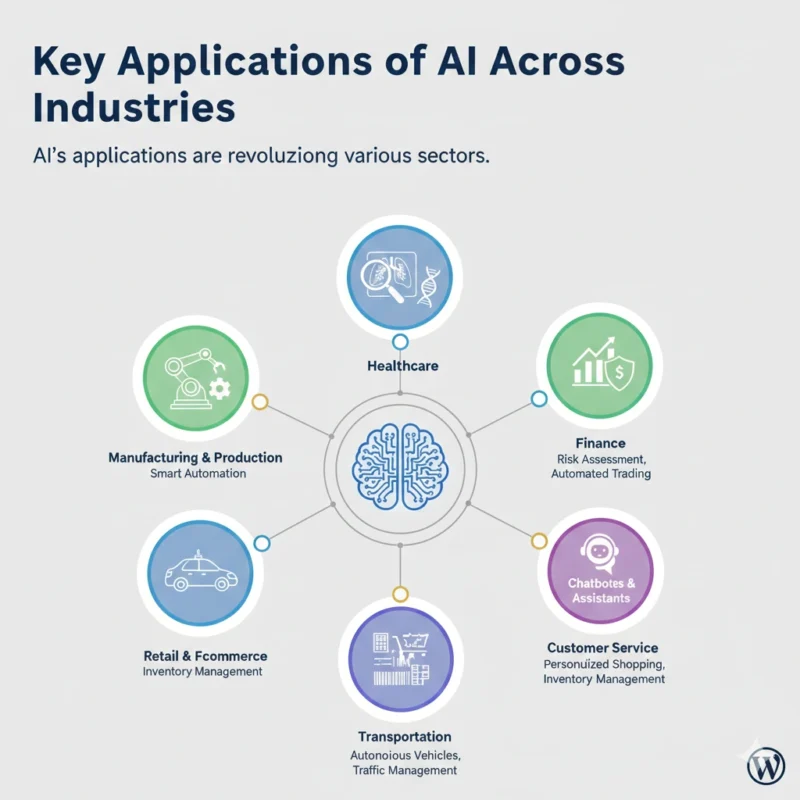
Key Applications of AI Across Industries
AI’s applications are revolutionizing various sectors. Let’s explore the specific industries benefiting from AI and automation:
- Manufacturing and Production
- Predictive Maintenance: AI anticipates when machines need maintenance, preventing unplanned downtime and extending equipment life.
- Smart Automation: AI-powered robots and machines handle repetitive tasks such as assembly and packaging, ensuring accuracy and efficiency.
- Healthcare
- Medical Imaging: AI analyzes medical images (e.g., X-rays, MRIs) to detect diseases like cancer early, improving diagnosis accuracy and speed.
- Drug Discovery: AI analyzes vast datasets to identify promising drug candidates, accelerating research and reducing time to market.
- Finance
- Risk Assessment: AI helps financial institutions make more informed decisions by assessing credit risk more accurately.
- Automated Trading: AI-driven algorithms analyze market trends and execute trades with precision, optimizing investment strategies.
- Retail and E-commerce
- Personalized Shopping Experience: AI enhances customer engagement by analyzing buying patterns and providing personalized recommendations.
- Inventory Management: AI predicts demand trends, helping retailers maintain optimal stock levels and reduce losses.
- Transportation
- Autonomous Vehicles: AI enables the development of self-driving cars, trucks, and drones, increasing safety and efficiency while reducing human error.
- AI-Driven Traffic Management: AI systems analyze traffic patterns in real time, helping to reduce congestion and improve public transportation systems.
- Customer Service
- Chatbots and Virtual Assistants: AI chatbots automate routine customer queries, improving service quality and reducing wait times.
Sentiment Analysis: AI analyzes customer feedback to identify trends and provide actionable insights to enhance customer satisfaction.
- Chatbots and Virtual Assistants: AI chatbots automate routine customer queries, improving service quality and reducing wait times.
Advantages of AI and Automation in Industries
The integration of AI and automation into industry processes provides numerous benefits:
- Increased Efficiency and Productivity:
AI frees up employees from manual tasks and accelerates production processes, increasing overall output without additional labor costs. - Cost Reduction:
Automation powered by AI minimizes operational costs by replacing repetitive tasks and reducing human errors, leading to lower expenses and fewer costly mistakes. - Enhanced Decision-Making:
AI processes large amounts of data quickly, helping businesses make informed decisions based on real-time insights and analytics. - Improved Customer Experience:
AI allows businesses to offer personalized experiences and faster response times, improving customer engagement and satisfaction. - Scalability and Flexibility:
AI allows companies to scale operations quickly and efficiently by managing large datasets, handling increased traffic, and adapting to changing market conditions without sacrificing quality.
The Future of AI and Automation
AI’s future is filled with exciting opportunities. As the technology continues to evolve, its role in shaping industries will grow exponentially.
- Advancements in Deep Learning and Neural Networks:
Deep learning algorithms will continue to evolve, improving AI’s ability to recognize patterns, understand language, and perform tasks that require human-like cognitive function. - AI-Powered Workforce Collaboration:
Rather than replacing workers, AI will enhance their capabilities by providing real-time insights, data analysis, and decision-making support. - Ethical AI:
As AI becomes more integrated into business practices, ethical considerations such as transparency, fairness, and privacy will become central. Regulations will evolve to ensure AI is used responsibly.
AI and the Internet of Things (IoT):
AI will collaborate with IoT devices to create smarter, more efficient systems. From smart homes to connected factories, AI will analyze real-time data to optimize operations, reduce energy consumption, and improve performance.
FAQs
Q1: How is AI improving productivity in industries?
AI automates mundane tasks, reduces errors, and allows workers to focus on strategic, creative activities, resulting in increased efficiency and productivity.
Q2: Will AI replace human jobs?
AI may replace certain repetitive tasks but is more likely to augment human jobs by handling data-heavy tasks, allowing employees to focus on more complex and creative work.
Q3: How can AI help in customer service?
AI chatbots and virtual assistants can answer customer queries instantly, providing round-the-clock support and ensuring high-quality service at scale.
Q4: Which industries are most impacted by AI and automation?
AI and automation are transforming sectors such as healthcare, manufacturing, finance, transportation, retail, and customer service by optimizing processes and improving outcomes.
Q5: What are the risks associated with AI and automation?
AI presents risks such as job displacement, data privacy concerns, and ethical dilemmas. However, with proper regulation and responsible use, these risks can be mitigated, ensuring that AI benefits businesses and society as a whole.
Conclusion
AI is no longer just a concept of the future,it is already reshaping industries worldwide. By embracing AI and automation, businesses can reduce costs, increase efficiency, and provide superior customer experiences, all while staying competitive in a rapidly evolving market.
The future of AI is poised for even greater advancements, from the development of ethical AI to the integration with IoT, creating smarter, more connected industries. As we continue to push the boundaries of AI, industries must adapt, innovate, and harness its power to stay ahead of the curve.

Good Information