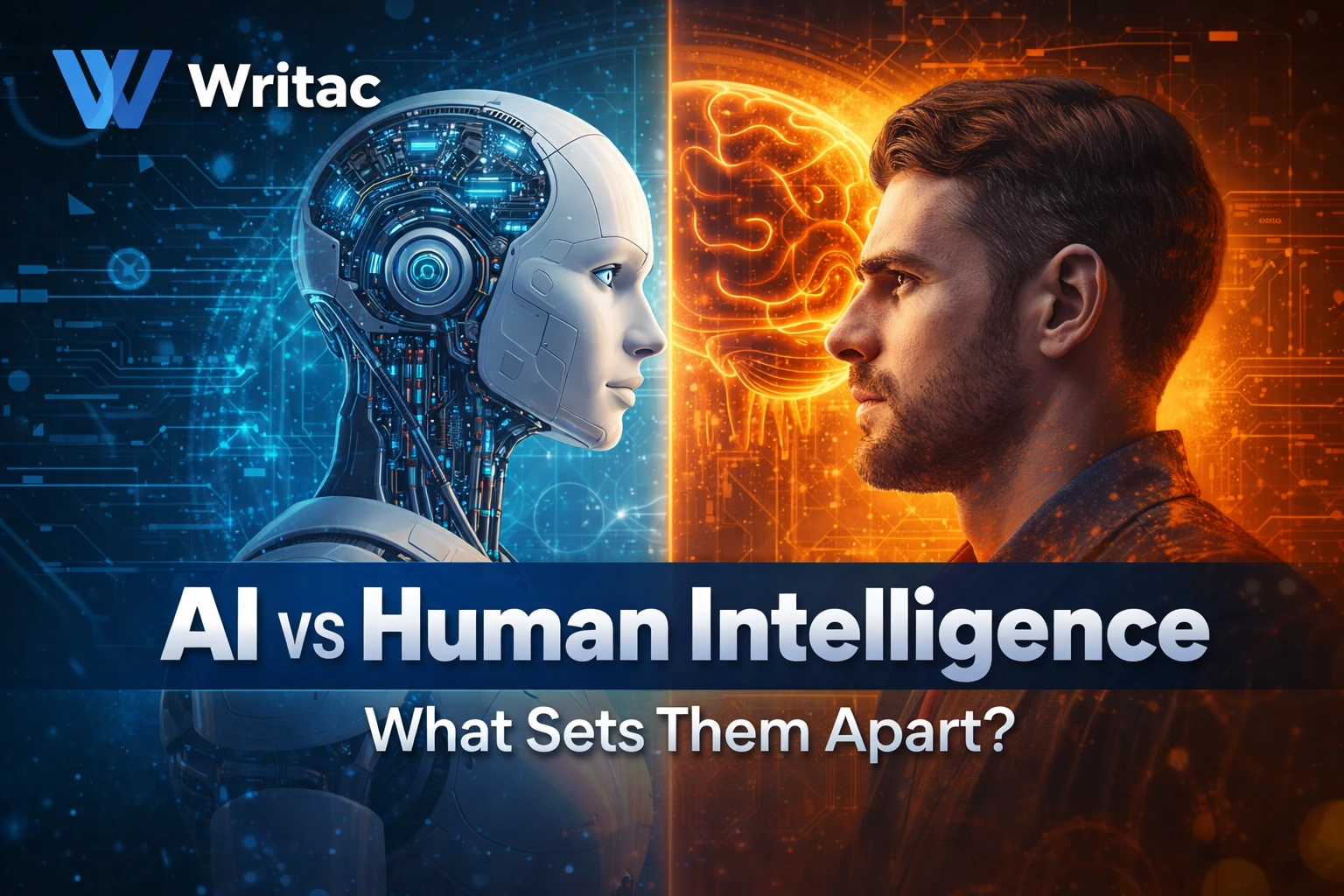
AI vs Human Intelligence: Key Differences in Thinking, Learning, and Creativity

The way we work, communicate, and solve problems is being revolutionized by artificial intelligence (AI). A common question that comes up as machines get smarter is how artificial intelligence (AI) differs from human intelligence. Human intelligence is still superior in terms of creativity, emotions, ethics, and consciousness, even though AI can process data incredibly quickly.
This blog examines AI vs human intelligence, outlining the main distinctions under each subheading in an understandable, point-by-point format. To help readers understand how humans and AI compare in today’s digital world, the content is simple to read, completely original, and optimized for modern SEO.
Understanding the Two Types of Intelligence
What Is Artificial Intelligence?
Artificial Intelligence refers to computer-based systems designed to perform tasks that normally require human thinking. AI operates using algorithms, data, and models trained to recognize patterns and make predictions.
Key characteristics of AI:
- Works on predefined algorithms and training data
- Learns through machine learning and deep learning models
- Excels at data-heavy and repetitive tasks
- Lacks emotions, self-awareness, and consciousness
Example: AI-powered recommendation systems on platforms like streaming apps analyze your viewing history and suggest content. While the system appears smart, it only follows data patterns, it does not understand personal taste or emotions.
What Is Human Intelligence?
Human intelligence is the natural mental ability of humans to think, reason, feel, imagine, and adapt. It is shaped by experiences, emotions, culture, ethics, and intuition.
Key characteristics of human intelligence:
- Learns from life experiences and emotions
- Uses creativity, intuition, and imagination
- Understands ethics, morality, and empathy
- Adapts naturally to new and unpredictable situations
Example:
A teacher adjusting their teaching style based on students’ moods and understanding levels shows human intelligence. This adaptation happens instinctively, without data models or programming.
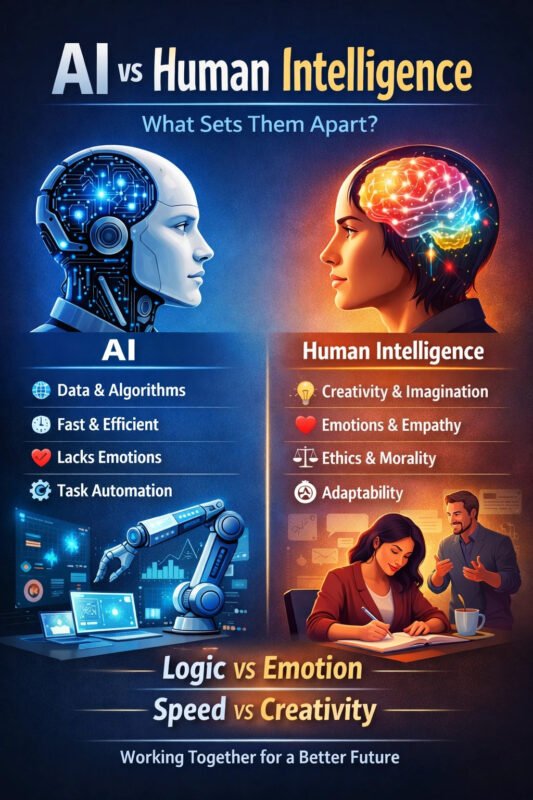
Key Differences Between AI and Human Intelligence
1. Learning and Adaptation
AI and humans learn in very different ways.
AI learning includes:
- Training on large datasets
- Learning patterns through repetition
- Requiring updates or retraining for new situations
Human learning includes:
- Learning from mistakes and experiences
- Adapting instantly to new environments
- Applying knowledge creatively across unrelated problems
Humans can generalize learning far better than AI.
Example:
An AI driving system must be retrained to handle new road conditions, while a human driver can immediately adjust when driving in fog, rain, or an unfamiliar city. Humans can generalize learning far better than AI.
2. Creativity and Original Thinking
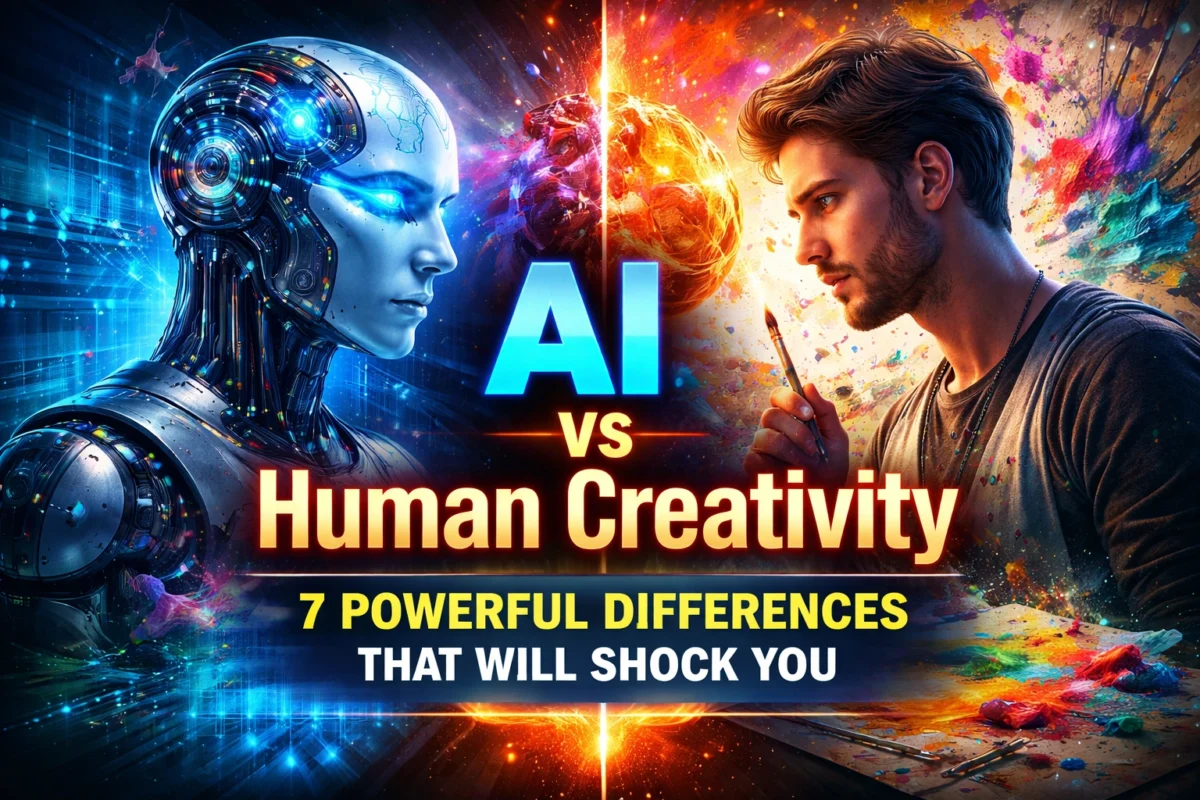
Creativity is one of the strongest distinctions between AI and humans.
AI creativity:
- Generates content based on existing data
- Combines known patterns in new formats
- Cannot imagine or innovate independently
Human creativity:
- Produces original ideas from imagination
- Creates art, stories, music, and inventions
- Thinks abstractly beyond data and rules
AI imitates creativity, but humans truly originate it.
Example:
AI can generate a painting inspired by thousands of artworks, but it cannot create a new art movement. Humans, however, invent entirely new styles, philosophies, and concepts.
AI imitates creativity, but humans truly originate it.
3. Emotional Intelligence
Emotions play a major role in intelligence.
AI and emotions:
- Detects emotions through data signals
- Responds based on programmed logic
- Does not feel emotions or empathy
Human emotional intelligence:
- Feels empathy, compassion, and connection
- Understands emotional context naturally
- Uses emotions to guide decisions and relationships
Example:
A customer support chatbot can respond politely, but a human agent can sense frustration, reassure the customer, and adapt tone naturally.
This makes humans essential in leadership, counseling, and social roles.
4. Decision-Making and Judgment
Decision-making styles differ significantly.
AI decision-making:
- Based on probabilities and data accuracy
- Follows rules without moral awareness
- Performs best in structured environments
Human decision-making:
- Considers ethics, values, and emotions
- Uses intuition alongside logic
- Handles moral dilemmas and gray areas
Humans bring responsibility and accountability to decisions.
Example:
AI can recommend the most cost-efficient medical treatment, but a doctor considers emotional, ethical, and personal factors before deciding what’s best for a patient.
Humans bring responsibility and accountability to decisions.
5. Speed and Efficiency
This is where AI clearly dominates.
AI strengths:
- Processes massive data in seconds
- Works 24/7 without fatigue
- Performs repetitive tasks flawlessly
Human limitations:
- Requires rest and focus
- Slower at large-scale data processing
- Prone to fatigue and errors
AI enhances productivity, but humans guide direction.
Example:
AI can analyze millions of financial transactions instantly, while humans would take weeks. However, humans decide how and why that analysis is used.
AI enhances productivity, but humans guide direction.
Strengths of Artificial Intelligence
Where AI Excels
AI is powerful when used correctly.
Major strengths of AI include:
- High-speed data analysis
- Automation of repetitive processes
- Predictive analytics and forecasting
- Consistent performance without bias from fatigue
AI is ideal for analytics, monitoring, and operational efficiency.
Example:
In manufacturing, AI predicts machine failures before they occur, reducing downtime and costs.
Strengths of Human Intelligence
Where Humans Excel
Human intelligence remains irreplaceable.
Major strengths of humans include:
- Ethical and moral reasoning
- Creative problem-solving
- Emotional understanding and empathy
- Cultural and social awareness
Humans bring meaning, purpose, and values to intelligence.
Example:
Human leaders inspire teams, resolve conflicts, and create vision,areas where AI cannot genuinely connect.
Can AI Replace Human Intelligence?
AI is not a replacement for human intelligence,it is a tool. The future belongs to collaboration, not competition.
Why AI cannot fully replace humans:
- No consciousness or self-awareness
- No genuine emotions or morality
- No independent purpose or intent
Why humans need AI:
- To increase efficiency
- To reduce workload
- To support data-driven decisions
Together, AI and humans create better outcomes.
The Future of AI and Human Intelligence
In the future, success will depend on how well humans and AI work together.
The ideal balance includes:
- AI handling automation and analytics
- Humans leading creativity, strategy, and ethics
- Responsible and transparent AI usage
- Continuous human learning and upskilling
Understanding the difference ensures we use AI wisely while protecting human values.
FAQs
1. What is the main difference between AI and human intelligence?
AI depends on data and algorithms, while human intelligence involves emotions, creativity, ethics, and consciousness.
2. Can AI think independently like humans?
No. AI simulates intelligence but does not have awareness, emotions, or free will.
3. Is AI smarter than humans?
AI is superior in speed and data processing, but humans excel in creativity, judgment, and emotional intelligence.
4. Will AI replace human jobs?
AI will automate tasks, not humanity. New roles requiring creativity and critical thinking will continue to grow.
5. How can humans stay relevant in the AI era?
By developing skills like creativity, strategic thinking, emotional intelligence, and ethical decision-making.