
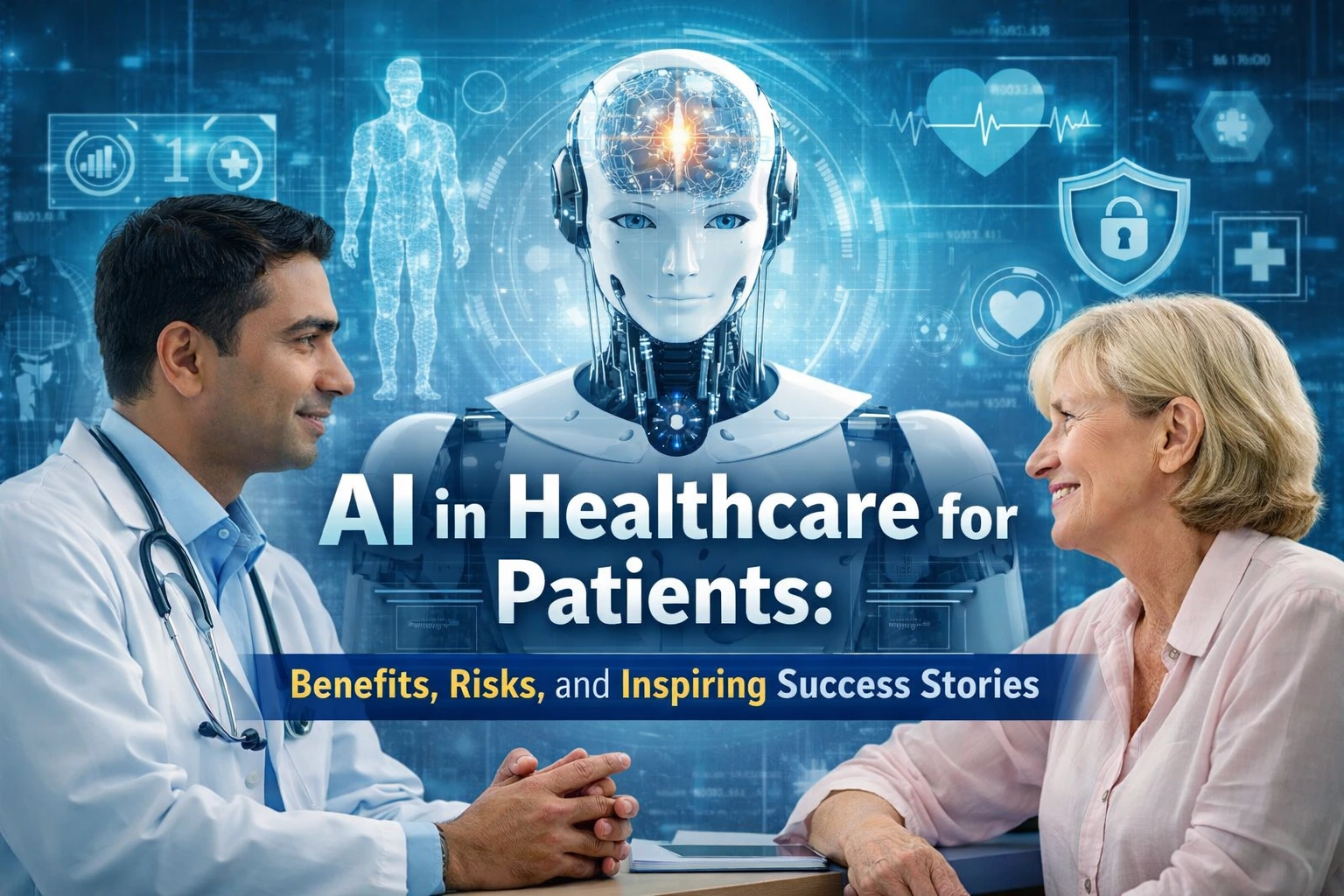
AI in Healthcare for Patients: Benefits, Risks, and Inspiring Success Stories

Today, advances in Artificial Intelligence technologies are changing how people are treated for medical illnesses. Many patients no longer have to wait long hours at a doctor or hospital for their doctor to give them care. Instead, AI-empowered healthcare provides customized patient treatment plans that provide the best care possible based on each patient’s unique needs. People are also able to manage their own healthcare from their own homes through the use of AI technologies.
The introduction of AI is positively impacting the way patients manage their health care by changing how they are monitored and how they receive care. In addition to improving the way patients manage their health, AI has also changed how people monitor their health and well-being.
While these improvements to health care are encouraging, there are still some concerns around trust, safety, and the privacy of data that people are sharing with AI technologies in the health care sector.

Understanding AI in Healthcare
Artificial intelligence in healthcare means that computers can look at large amounts of medical data, find patterns, and help doctors make decisions about the treatment of patients. The use of these systems helps doctors do their jobs better, rather than taking over their responsibilities. In addition, AI gives patients: Faster access to critical information related to their health; More accurate diagnosis of their disease; and Patient-specific care, as opposed to blanket care provided to all patients. AI also helps turn complicated medical data into decisions that result in saving lives.
How AI Is Transforming Patient Care
Early and Accurate Disease Detection
AI is now revolutionizing early diagnosis. AI systems can identify diseases in their early stages, frequently before symptoms become apparent, by examining lab reports, patient histories, and medical scans.
This early identification results in:
- Increased rates of treatment success
- Lower medical expenses
- Plans for less aggressive treatment
Early responses frequently provide patients with peace of mind or prompt action when it counts most.
Personalized Treatment for Every Patient
AI gives physicians the ability to create individualized treatment protocols for their patients based upon:
- Genetic Factors
- Lifestyle Habits
- Personal Medical Histories
Because of this personalized approach, there is significantly reduced risk of adverse reactions to medications, and significantly improved effectiveness of medication plans for patients suffering with certain types of diseases, including Cancer, Diabetes, and Autoimmunity.
Improved Access to Healthcare Services
AI chatbots and virtual health applications support patients by providing immediate access to care whenever and wherever they are located.
- Ask health-related questions
- Schedule appointments
- Get reminders for medications
- Remotely monitor their symptoms
For patients living in rural or underserved areas, AI helps connect them with physicians and other medical professionals.
AI in Everyday Patient Life
Virtual Health Assistants and Chatbots
Digital Health Companion AI Assistants are designed to support patients in maintaining symptom and treatment plan records, while also assisting patients with medication adherence; particularly helpful to older adults, and those dealing with chronic conditions.
These tools offer increased levels of engagement between patients and their providers; ultimately decreasing return visits to healthcare facilities.
Wearable Devices and Remote Monitoring
AI-driven smartwatches and wearable technology continuously measure critical signs of life such as:
- Heart rate
- Blood Pressure
- Oxygen levels
- Sleep Patterns
When an abnormality is detected, real-time notifications can be sent which protects against future emergencies and allows for prompt intervention.
Real-Life Success Stories of AI in Healthcare
AI Revolutionizing Cancer Detection
- Breast, lung, and skin cancer detection with AI systems is very accurate; much sooner than normal screening technology finds abnormality. Patients now have: A Better Chance For treatments
- Better End Of Life/Product Resolution Procedures Greater Survival for Their Lives When Diagnosed With These Conditions.
Preventing Heart Disease with AI
AI utilizes ECG signal data and patient medical records to produce predictions of the future risk of heart disease in patients. With early warning of potential problems, patients can begin implementing lifestyle changes and preventative measures well in advance of any significant complications from heart disease.
AI Supporting Mental Health Patients
AI Powered Mental Health Applications Provide Anxiety / Depression / Stress Management Solutions By Providing Emotional Pattern Tracking, Guided Exercise, Through Supporting Development of Healthy Lifestyle Routines. Daily Use of These Tools May Support Individuals Who Do Not Have Immediate Access to Therapists.
Key Risks and Challenges for Patients:
Threats & Risk to the Privacy and Security of Data
The use of AI requires health information be available; however, if individuals do not follow proper security procedures, individuals’ health information may be accessed and/or misused without their consent. To create patient confidence in AI systems’ use of their health information, AI systems must establish adequate protection from unauthorised access to health data using transparent processes, including through both regulatory and legal processes.
Bias and Fairness in AI Systems
AI systems can only be trusted to perform fairly if they have received a high-quality set of training data. AI that has been trained based upon inadequate, incomplete, or otherwise slanted (biased) data will almost certainly create disparities when rendering services among various groups. Achieving equal access to care for all patients requires that there exists an ongoing process for evaluating and improving AI training data through the inclusion of diverse, adequately represented populations.
Excessive reliance on technology
The use of artificial intelligence (AI) should not be used in place of the judgement of a physician. Physicians offer compassion, experience and morality,traits which are not replicable through technology. By combining the talents of both practitioners with the benefits of AI, a synergy is created to yield the best possible outcomes for all patients
The Future of Artificial Intelligence in Patient Oriental Health Care
AI provides healthcare with a proactive look instead of reactively treating disease after it occurs. AI enables providers to engage in preventing disease prior to its onset.
Advancements on the horizon may include the following:
- Home based health care with insight from biometric analysis
- The prediction of disease from the point of service in terms of both time and space
- Increased patient control over their own health information
The goal of AI is not to eliminate the human connection; the goal of AI is to augment and therefore, to strengthen that connection.
FAQs
1. Will Artificial Intelligence (AI) be a safe option for Patients?
If appropriately utilized, legally regulated, appropriately managed along with policies in place for patient confidentiality and performed by Qualified Healthcare Professionals, Artificial Intelligence can be a safe alternative for patients.
2. Is Artificial Intelligence (AI) going to take the place of Doctors?
Doctors will be getting vital information and resources to support them in addition to their medical training through the use of Artificial Intelligence . However, doctors will continue to provide care with empathy, compassion and understanding – qualities that AI cannot replace.
3. Is Artificial Intelligence (AI) an Accurate Tool in Diagnosing Patients?
Artificial Intelligence can analyze large amounts of medical data to identify patterns and trends that may not be identified by human evaluation. This means the implementation of AI in medicine will increase the speed of diagnosis and raise the accuracy of diagnosis.
4. Will Patients Be Able to Use Artificial Intelligence Technologies?
Wearable devices, mobile health apps and virtual health assistants can enable patients to access remote healthcare services and monitor their health at home.
5. Will Artificial Intelligence (AI) Reduce the Cost of Healthcare?
By utilizing Artificial Intelligence (AI), patients can save on the costs of long-term treatments by integrating preventive healthcare and the ability to identify illnesses in their earliest stages.
Conclusion
AI in health care is transforming how patients interact with their health and reshaping health care into a more efficient, accurate, personalized experience. Although there are significant challenges associated with data privacy and the potential for biased algorithms that need to be addressed, the benefits greatly exceed the risks if we implement these technologies responsibly.
For patients, AI will open a door to a future in which health care is not only high-tech but also affordable, preventative and completely oriented toward the patient’s needs.









2 thoughts on “AI in Healthcare for Patients: Benefits, Risks, and Inspiring Success Stories”