How AI Is Detecting Cancer Earlier Than Ever Before in 2026: The Future of Life-Saving Diagnosis

Introduction – Why Early Cancer Detection Matters More Than Ever
Cancer continues to be one of the most serious health challenges worldwide. According to the World Health Organization (WHO), cancer remains a leading cause of death globally, accounting for millions of deaths each year. Every year, millions of families are affected by a diagnosis that changes lives instantly. Yet one truth remains constant in medicine: early detection saves lives.
When cancer is identified at Stage 1, treatment options are more effective, less invasive, and survival rates can exceed 90% for certain cancers. Data from the American Cancer Society shows that early-stage detection significantly improves long-term survival outcomes.
Unfortunately, many cases are still diagnosed at later stages when symptoms finally appear.
That’s where technology is stepping in. In 2026, AI Is Detecting Cancer earlier than ever before, giving patients something incredibly powerful, time. Time for early treatment. Time for better outcomes. Time for hope.
This is no longer futuristic science. Across hospitals and research centers worldwide, AI Is Detecting Cancer using advanced imaging, genetic analysis, and predictive algorithms that can identify warning signs long before traditional methods. Research published by institutions such as the National Cancer Institute (NCI) highlights how artificial intelligence is transforming oncology through machine learning and predictive diagnostics.
What Does AI in Cancer Detection Really Mean?
Artificial intelligence in oncology refers to smart computer systems trained to recognize patterns in massive medical datasets. These systems learn from millions of scans, pathology reports and genetic profiles to identify subtle abnormalities that humans might miss.
Unlike traditional software, AI improves over time. The more data it processes, the more accurate it becomes.
Machine Learning in Oncology
Machine learning models analyze medical images and patient histories to detect patterns linked to tumor growth. In many cases, AI Is Detecting Cancer at stages so early that even experienced specialists would struggle to notice the changes.
This doesn’t replace doctors , it strengthens their ability to diagnose faster and more accurately.
Deep Learning & Medical Imaging
Deep learning, a specialized branch of AI, uses neural networks that mimic how the human brain processes information. These systems are now commonly used to analyze:
- Mammograms
- CT scans
- MRI scans
- PET scans
In 2026, radiology departments increasingly rely on AI as a second reader. In fact, AI Is Detecting Cancer in imaging scans with remarkable precision, highlighting suspicious areas in seconds.
Predictive Analytics in Healthcare
Beyond detecting existing tumors, AI can estimate future cancer risk. By analyzing genetic mutations, lifestyle patterns, and clinical history, AI Is Detecting Cancer risk before physical symptoms ever develop.
This shift from reactive to preventive care marks a major transformation in modern medicine.
How AI Detects Cancer Earlier Than Traditional Methods
Traditional diagnostics depend heavily on human observation. While doctors are highly trained, they face time constraints, heavy workloads, and natural fatigue. Even the best specialists can miss subtle warning signs.
AI adds an extra layer of precision.
AI in Radiology
Modern AI systems can analyze thousands of medical images within minutes. For example:
- In mammography, AI improves early breast cancer detection while reducing false positives.
- In lung screening, AI identifies tiny nodules that may signal early-stage lung cancer.
In many screening programs, AI Is Detecting Cancer months , sometimes even a year , before conventional review would flag the abnormality.
AI-Powered Liquid Biopsies
Liquid biopsies are blood tests that detect fragments of tumor DNA circulating in the bloodstream. These fragments are incredibly small and complex to interpret.
AI systems process this molecular data rapidly, identifying cancer signals at a microscopic level. Through this method, AI Is Detecting Cancer before tumors are visible on scans.
AI in Pathology & Tissue Analysis
Traditionally, pathologists examine tissue slides under microscopes. Now, digital pathology platforms powered by AI scan high-resolution slides and identify abnormal cell structures with impressive accuracy.
By assisting pathologists, AI Is Detecting Cancer faster, reducing diagnostic delays and improving treatment timelines.
Genomics and Personalized Risk Prediction
Cancer often begins with genetic mutations. AI analyzes genomic sequencing data to identify inherited risks and recommend earlier screenings.
This personalized approach means AI Is Detecting Cancer risk at the individual level , not just the population level.
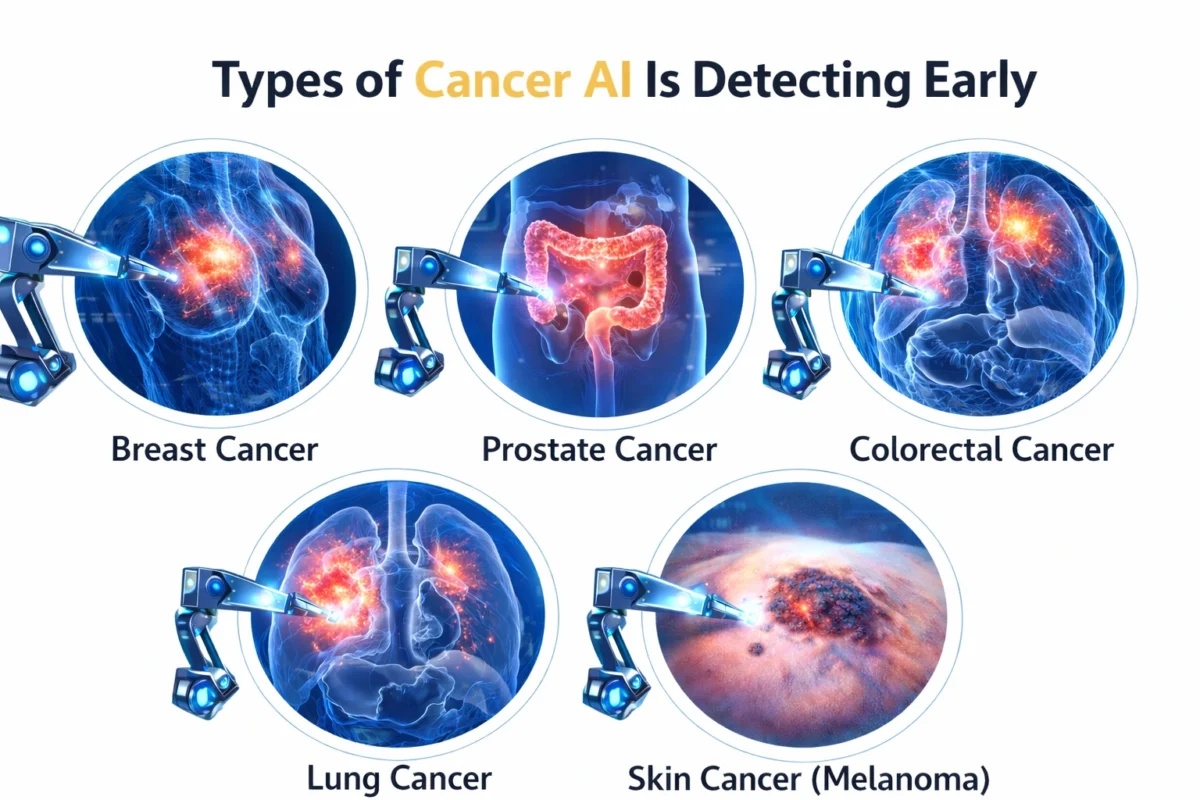
Types of Cancer Being Detected Earlier in 2026
AI’s impact is especially strong in common, high-risk cancers.
Breast Cancer
AI-powered mammograms reduce missed diagnoses and minimize unnecessary biopsies. Screening programs using AI report improved early detection rates.
Lung Cancer
Among smokers and high-risk groups, AI lung screening tools identify tumors at Stage 1, dramatically increasing survival rates.
Prostate Cancer
AI-enhanced MRI analysis helps distinguish aggressive tumors from slow-growing ones, preventing overtreatment while catching dangerous cancers early.
Colorectal Cancer
During colonoscopies, AI-assisted systems highlight suspicious polyps in real time, helping doctors remove them immediately.
Skin Cancer
Dermatology apps using computer vision technology analyze skin lesions with near-expert accuracy. In many clinical settings, AI Is Detecting Cancer in melanoma cases earlier than visual inspection alone.
Real-World Impact: Saving Lives Through Early Detection
Hospitals integrating AI into screening programs report measurable improvements:
- Reduced false negatives in breast cancer screening
- Faster pathology turnaround times
- Earlier identification of high-risk lung nodules
Most importantly, patients begin treatment sooner , when it is most effective.
Doctors consistently emphasize that AI is not replacing human expertise. Instead, it acts as a highly intelligent assistant. When human judgment combines with machine precision, outcomes improve significantly.
Benefits of AI in Early Cancer Detection
Higher Survival Rates
The earlier cancer is caught, the better the prognosis. AI increases the chances of identifying tumors at treatable stages.
Faster Diagnosis
AI processes scans in seconds, reducing waiting times and anxiety for patients.
Reduced Human Error
Consistency is one of AI’s strengths. It doesn’t get tired or distracted.
Lower Healthcare Costs
Treating early-stage cancer is far less expensive than managing advanced disease. Early detection reduces financial strain on both patients and healthcare systems.
Challenges and Ethical Considerations
Despite its promise, AI in oncology is not without challenges.
Data Privacy
AI systems require large datasets. Ensuring patient confidentiality is essential.
Bias in Algorithms
If AI models are trained on limited populations, accuracy may vary across demographic groups. Diversity in medical data is critical.
Regulatory Oversight
Before clinical use, AI tools must undergo rigorous validation and approval processes.
The Human Element
Patients still need empathy, communication and trust, qualities only human healthcare professionals can provide. AI is a support tool, not a substitute for compassionate care.
The Future of AI in Oncology Beyond 2026
The evolution of cancer detection is just beginning.
Wearable health devices may soon monitor biomarkers continuously. AI could analyze subtle biological signals from blood, breath, or other indicators long before traditional diagnostics would notice anything unusual.
Researchers are also using AI to accelerate cancer drug discovery, identifying promising treatment molecules in record time.
The long-term vision? A world where cancer is detected so early that it becomes easier to treat and far less deadly.
Conclusion – A New Era in Cancer Diagnosis
In 2026, the healthcare landscape is changing rapidly. With breakthroughs in machine learning, imaging analysis, genomics, and predictive modeling, artificial intelligence is reshaping oncology.
AI Is Detecting Cancer earlier, faster, and with greater precision than ever before. It is helping doctors make better decisions, improving survival rates, and giving patients renewed hope. The future of cancer diagnosis is not about machines replacing doctors. It is about collaboration , human expertise powered by intelligent technology.
Early detection saves lives and in 2026, technology is making early detection smarter than ever.
FAQs
1-What is AI in cancer detection?
AI in cancer detection uses machine learning and deep learning algorithms to analyze medical images, genetic data, and patient records to identify early signs of cancer.
2-Can AI detect cancer before symptoms appear?
Yes. In some cases, AI can detect subtle biological or imaging patterns that indicate cancer risk before symptoms develop.
3-Is AI more accurate than doctors at detecting cancer?
AI can match or exceed human accuracy in specific tasks like image analysis. However, it works best when combined with medical professionals.
4-What types of cancer can AI detect early?
AI is widely used in detecting breast cancer, lung cancer, prostate cancer, colorectal cancer, and skin cancer.
5-Is AI cancer detection safe?
AI tools undergo rigorous clinical testing and regulatory approval. When properly validated, they are safe and highly effective diagnostic aids.
Ready to Dominate the Healthcare Content Space?
Stop falling behind. Start publishing powerful, SEO-optimized AI healthcare content with Writac today.
Create smarter. Rank faster. Convert more.