
Introduction: The Hidden Danger Behind Smart Machines
What if an AI system denied you a job, flagged you as suspicious or made a life-changing decision about your future and you had no idea why?
This is not science fiction. It’s already happening.
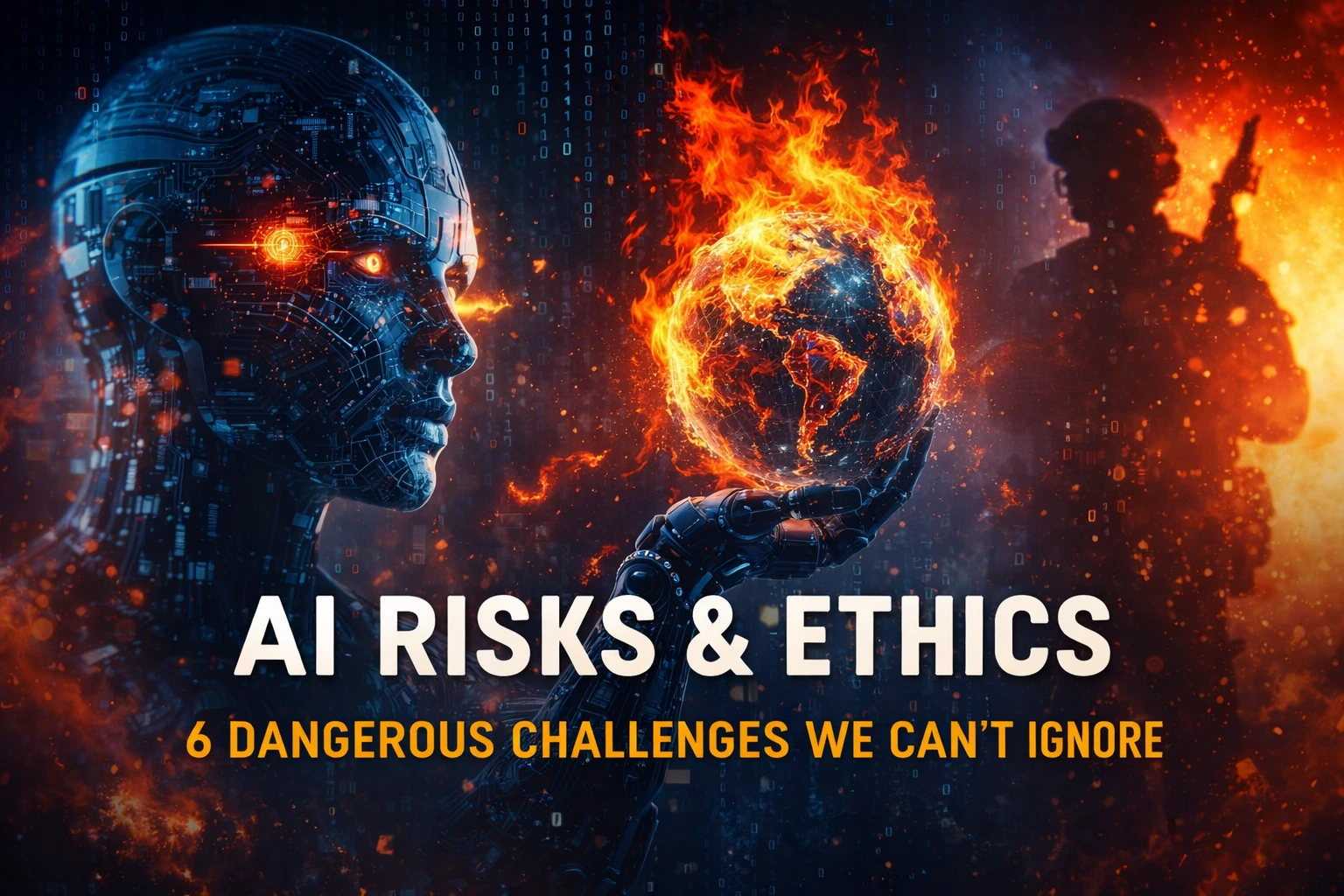
Artificial Intelligence is transforming industries, improving efficiency and unlocking new possibilities. But behind this rapid progress lies a growing concern that cannot be ignored: AI risks.
From biased decisions to privacy violations and misinformation, these risks are shaping the future of society in ways we are only beginning to understand.
What Are AI Risks?
AI risks refer to the potential negative consequences of artificial intelligence systems, ranging from ethical issues to economic and security threats.
According to a PwC report, AI could contribute up to $15.7 trillion to the global economy by 2030, but without proper safeguards, the same technology could also amplify inequality and systemic risks.
Understanding these challenges is essential to ensure AI benefits humanity rather than harms it.
1. Bias and Discrimination in AI Systems
AI systems learn from historical data, which often contains hidden biases. As a result, these systems can unintentionally discriminate.
Why It Matters:
- Reinforces social inequalities
- Affects hiring, lending and law enforcement
- Scales discrimination faster than humans
Real Insight:
A MIT study found that facial recognition systems had error rates of up to 34% for darker-skinned women, compared to less than 1% for lighter-skinned men.
Solution:
- Use diverse datasets
- Conduct regular audits
- Implement fairness-focused models
Bias is not just a technical flaw, it’s a societal issue embedded in technology.
2. Privacy Violations and Data Exploitation
AI relies heavily on data, often personal and sensitive.
Why It Matters:
- Users are tracked and profiled
- Data can be misused or leaked
- Surveillance is becoming more advanced
Real Insight:
A McKinsey report highlights that companies using AI-driven personalization can increase revenue by 10–30%, but this often comes at the cost of extensive data collection.
Solution:
- Strengthen privacy regulations
- Use anonymization techniques
- Be transparent about data usage
Balancing innovation with privacy is one of the biggest challenges today.
3. Job Displacement and Economic Inequality
Automation is reshaping the workforce, creating both opportunities and risks.
Why It Matters:
- Routine jobs are disappearing
- Workers may struggle to adapt
- Wealth may concentrate in large tech firms
Real Insight:
According to McKinsey Global Institute, up to 800 million jobs worldwide could be displaced by automation by 2030.
Solution:
- Invest in reskilling programs
- Promote human-AI collaboration
- Support workforce transitions
The future of work depends on how we prepare today.
4. Lack of Transparency (The Black Box Problem)
Many AI systems operate in ways that are difficult to understand.
Why It Matters:
- Decisions cannot be explained
- Errors are hard to detect
- Trust in AI decreases
Example:
An AI system rejects a loan application, but provides no clear reason.
Solution:
- Develop explainable AI (XAI)
- Increase transparency standards
- Provide decision insights
Trust is impossible without understanding.
5. AI Misuse and Security Threats
AI can be used for harmful purposes, from cyberattacks to autonomous weapons.
Why It Matters:
- Enables sophisticated cybercrime
- Can be weaponized
- Hard to regulate globally
Example:
AI-generated phishing attacks are now more convincing and harder to detect.
Solution:
- Enforce global AI regulations
- Monitor high-risk applications
- Promote ethical development
Technology itself is neutral, its use determines its impact.
6. Deepfakes and Misinformation
AI-generated content is becoming increasingly realistic.
Why It Matters:
- Spreads false information
- Damages reputations
- Undermines trust in media
Real Insight:
Deepfake content online has grown exponentially, with reports showing a 900% increase in recent years.
Solution:
- Develop detection tools
- Educate users
- Regulate malicious use
Truth is becoming harder to distinguish from fiction.
AI Risks Comparison Table
| AI Risk | Description | Impact Level | Real-World Example | Solution |
| Bias & Discrimination | AI systems produce unfair results due to biased training data | High | Hiring tools favoring certain groups | Use diverse data & audit algorithms |
| Privacy Violations | Collection and misuse of personal data without proper consent | High | User tracking by apps and platforms | Strong data protection & transparency |
| Job Displacement | Automation replacing human jobs | High | Chatbots replacing customer support roles | Reskilling & AI-human collaboration |
| Lack of Transparency | AI decisions are not explainable (“black box”) | Medium | Loan rejection without explanation | Develop explainable AI (XAI) |
| AI Misuse & Security | AI used for harmful purposes like cyberattacks or weapons | Very High | AI-powered phishing or autonomous weapons | Regulation & ethical guidelines |
| Deepfakes & Misinformation | AI-generated fake content spreading false information | Very High | Deepfake videos of public figures | Detection tools & media awareness |
Why AI Ethics Matters
Ethics is the foundation for reducing risks and ensuring responsible AI use.
Core Principles:
- Fairness – Avoid discrimination
- Transparency – Ensure clarity
- Accountability – Take responsibility
- Privacy – Protect data
- Safety – Prevent harm
Ethical AI is not optional, it’s essential.
The Role of Governments and Businesses
Governments Should:
- Create clear regulations
- Protect citizens’ data
- Promote ethical AI research
Businesses Should:
- Conduct regular audits
- Adopt ethical frameworks
- Prioritize user trust
Collaboration is key to managing risks effectively.
The Future of AI Risks
As AI evolves, new challenges will emerge, including:
- Artificial General Intelligence (AGI)
- Increased human dependency
- Autonomous decision-making
The decisions we make today will shape the future of AI.
Final Thoughts
AI has the potential to revolutionize the world, but it also comes with serious challenges. Ignoring these risks could lead to long-term consequences, while addressing them responsibly can unlock immense benefits.
The goal is simple: build AI that works for humanity, not against it.
FAQ:
1. What are AI risks?
AI risks are the potential negative impacts of artificial intelligence, including bias, privacy violations, job loss and misuse.
2. Why are AI risks important?
They affect individuals, businesses, and society, influencing fairness, security and trust in technology.
3. Can AI be dangerous?
Yes, if not properly regulated, AI can lead to discrimination, misinformation and security threats.
4. How can AI risks be reduced?
By implementing ethical guidelines, improving transparency and enforcing regulations.
5. Will AI replace human jobs?
AI may replace some jobs, but it will also create new opportunities requiring different skills.
Call to Action
The future of AI is being shaped right now and your awareness matters.
If this article helped you understand the real risks behind artificial intelligence, don’t keep it to yourself. Share it with others and spread awareness.
Have thoughts or questions?
💬 Drop a comment below, we’d love to hear from you.
For more powerful insights on AI, technology and digital trends, stay connected with Writac and stay ahead of the future.