AI Software vs Traditional Software: 5 Key Differences Explained

If you’ve been following tech trends lately, you’ve probably noticed one thing: AI is everywhere. From chatbots replying to customers to tools predicting sales, AI-based software is slowly becoming the backbone of modern software solutions.
But here’s a question I often hear from bloggers, founders, and even developers:
What is the real difference between AI software and traditional software?
This article breaks down AI Software vs Traditional Software in a simple, practical way, without buzzwords, without hype. Just real differences, real examples, and honest insights you can actually use.
Understanding the Basics First
Before we dive into the differences, let’s quickly set the foundation.
What Is Traditional Software?
Traditional software systems are built on rule-based logic. A developer defines rules, conditions, and workflows. The software follows those instructions exactly—nothing more, nothing less.
Example:
- Calculator apps
- Payroll software
- Basic inventory management systems
What Is AI Software?
AI software uses artificial intelligence technology, often powered by machine learning software, to analyze data, learn patterns, and improve over time.
Example:
- Recommendation engines (Netflix, Amazon)
- Chatbots and virtual assistants
- Fraud detection systems
Instead of only following rules, AI-based software learns from experience.
AI Software vs Traditional Software: 5 Key Differences Explained
Let’s get into the core comparison.
1. Learning Ability: Static vs Self-Improving
This is the biggest difference between AI and traditional software.
Traditional Software Systems
- Do not learn
- Work the same way today as they did on day one
- Need manual updates to improve functionality
If something changes in the environment, the software won’t adapt unless a developer updates it.
AI Software
- Learns from data
- Improves accuracy over time
- Uses machine learning to adapt automatically
Real-world insight:
I’ve seen customer support teams switch from rule-based chatbots to AI-driven applications. The AI chatbot didn’t just answer more questions, it got better every month without constant reprogramming.
Winner: AI Software
2. Decision-Making: Fixed Rules vs Intelligent Insights
Rule-Based Software
Traditional software makes decisions using predefined rules.
- If age < 18 → deny access
- If password incorrect → show error
No flexibility. No context.
AI Technology in Software
AI software analyzes patterns and context before making decisions.
- Detects unusual login behavior
- Flags suspicious transactions
- Suggests actions instead of just executing commands
Example:
A rule-based system blocks payments over a fixed amount.
An AI system analyzes spending behavior and blocks only suspicious transactions.
This is where smart software systems truly shine.
3. Adaptability: Manual Updates vs Real-Time Adjustment
Traditional Software
- Needs regular updates
- Cannot handle unexpected situations
- Breaks easily when inputs change
AI Based Software
- Adapts to new data
- Handles uncertainty better
- Works well in dynamic environments
Personal observation:
In content marketing tools, traditional keyword tools give static data. AI-driven tools adjust recommendations based on trends, seasonality, and user behavior,huge difference in results.
4. Accuracy & Prediction: Past Data vs Future Insights
Traditional Software Systems
- Focus on current or historical data
- No prediction capability
- Outputs are limited to programmed logic
AI Software
- Predicts outcomes
- Identifies hidden patterns
- Helps with forecasting and planning
Examples of AI-driven applications:
- Sales forecasting
- Demand prediction
- Customer churn analysis
This predictive power is why AI is becoming essential in modern software solutions.
5. Automation Level: Basic Tasks vs Intelligent Automation
Traditional Software
- Automates repetitive tasks
- Requires constant human supervision
- Limited to structured workflows
AI Software
- Automates decision-making
- Handles complex processes
- Reduces human effort significantly
Example comparison:
| Task | Traditional Software | AI Software |
| Customer Support | Ticket routing | Auto-resolution + sentiment analysis |
| Marketing | Email scheduling | Personalized content suggestions |
| HR | Resume filtering | Skill & behavior prediction |
When Traditional Software Still Makes Sense
Despite all the hype, traditional software isn’t dead.
It still works best when:
- Rules are clear and fixed
- Data volume is low
- Budget is limited
- Predictability is required
Example: Accounting software, basic CMS platforms, internal tools.
When AI Software Is the Better Choice
Choose AI software when:
- Data is large and constantly changing
- Decisions require context
- Automation can save time and money
- Personalization is important
AI-driven applications are especially useful in marketing, finance, healthcare, and SaaS products.
Practical Tips for Bloggers & Businesses
Here are some real-world takeaways you can apply:
- Don’t use AI just for the buzz – use it where learning and prediction matter
- Combine both – many successful tools mix traditional logic with AI modules
- Start small – AI features can be added gradually
- Focus on user value, not complexity
From an SEO perspective, content around AI Software vs Traditional Software performs well because it answers comparison-based search intent—users want clarity, not marketing talk.
The Future of Software Development
The future isn’t AI vs traditional software,it’s AI + traditional software.
Most successful platforms today:
- Use traditional systems for stability
- Use AI for intelligence and growth
That balance is what defines next-generation modern software solutions.
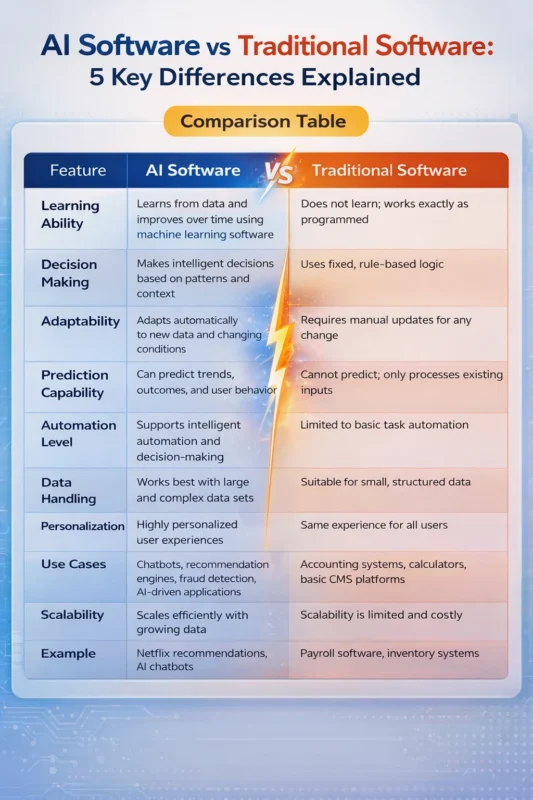
AI Software vs Traditional Software Comparison Table
Comparison Table
| Feature | AI Software | Traditional Software |
| Learning Ability | Learns from data and improves over time using machine learning software | Does not learn; works exactly as programmed |
| Decision Making | Makes intelligent decisions based on patterns and context | Uses fixed, rule-based logic |
| Adaptability | Adapts automatically to new data and changing conditions | Requires manual updates for any change |
| Prediction Capability | Can predict trends, outcomes, and user behavior | Cannot predict; only processes existing inputs |
| Automation Level | Supports intelligent automation and decision-making | Limited to basic task automation |
| Data Handling | Works best with large and complex data sets | Suitable for small, structured data |
| Personalization | Highly personalized user experiences | Same experience for all users |
| Use Cases | Chatbots, recommendation engines, fraud detection, AI-driven applications | Accounting systems, calculators, basic CMS platforms |
| Scalability | Scales efficiently with growing data | Scalability is limited and costly |
| Example | Netflix recommendations, AI chatbots | Payroll software, inventory systems |
Conclusion: AI Software vs Traditional Software
To sum it up, the difference between AI and traditional software comes down to intelligence, adaptability, and learning.
Traditional software systems are reliable and predictable.
AI software is flexible, smart, and future-ready.
If your goal is automation with insight, personalization, and scalability, AI Software vs Traditional Software isn’t a debate anymore, AI is clearly leading the way.
FAQs
1. What is the main difference between AI software and traditional software?
The main difference is learning ability. AI software learns from data, while traditional software follows fixed rules.
2. Is AI software better than traditional software?
Not always. AI is better for dynamic, data-driven tasks, while traditional software works well for stable, rule-based processes.
3. Can AI software replace traditional software completely?
No. Most systems use a combination of both for best results.
4. Is AI software expensive to implement?
Costs vary. Many AI-based software tools are now affordable and scalable for small businesses.
5. Which industries benefit most from AI-driven applications?
Marketing, healthcare, finance, e-commerce, and SaaS platforms benefit the most from AI technology in software
Call to Action
Want to scale your marketing without extra effort? Writac helps you create smarter content, improve performance, and work faster using AI-driven solutions. Start with Writac today and watch your ideas turn into growth.