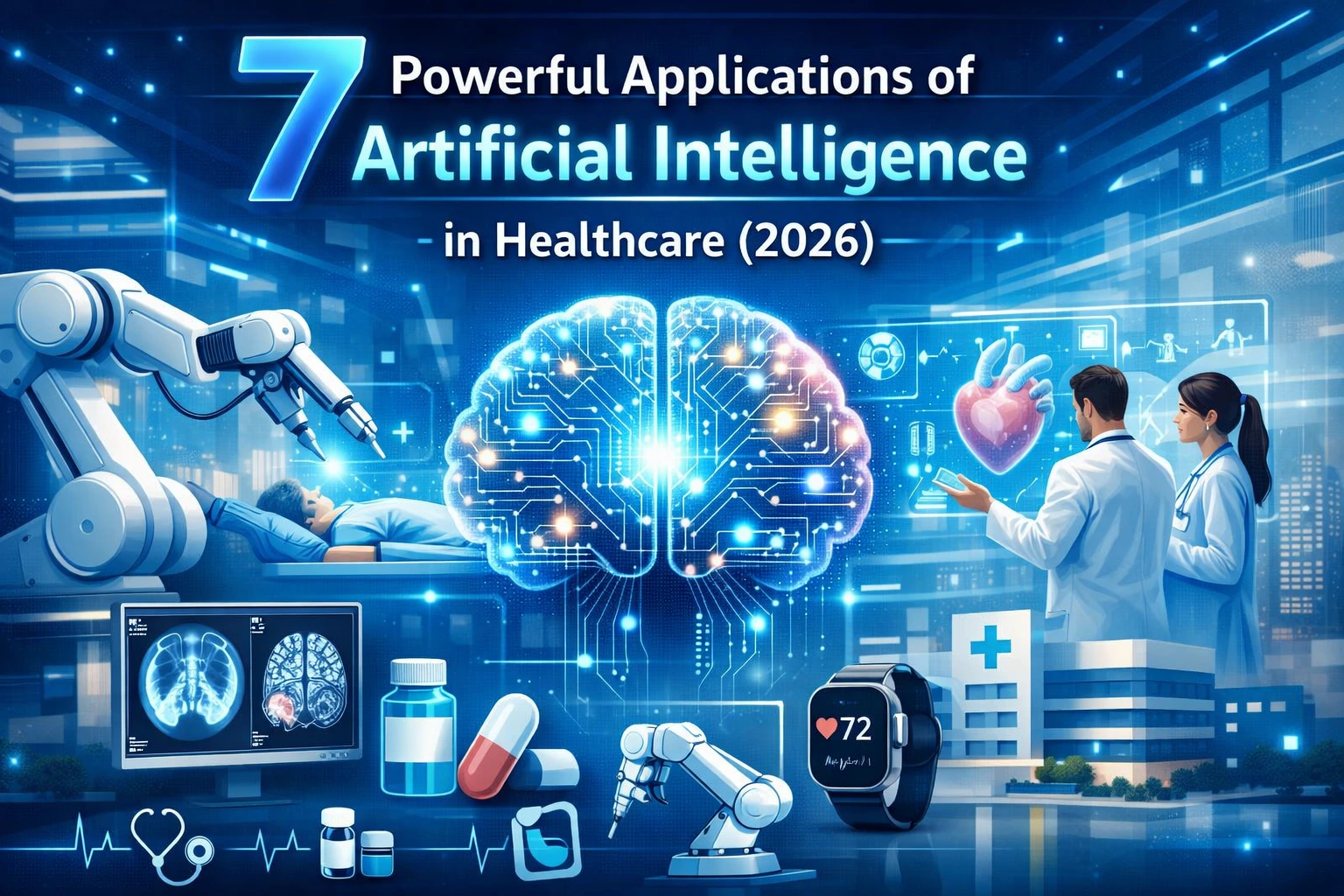
7 Powerful Applications of Artificial Intelligence in Healthcare in 2026

What if doctors could detect diseases earlier, make faster decisions and provide more accurate treatments using intelligent technology? Artificial Intelligence is making this possible by transforming how healthcare systems operate and improving the quality of patient care.
Artificial Intelligence (AI) is rapidly transforming the healthcare industry by improving how diseases are diagnosed, treated and monitored. With the growing amount of medical data and increasing demand for healthcare services, traditional methods alone are no longer sufficient. AI technologies help healthcare professionals analyze complex medical information quickly and accurately, enabling faster diagnoses and more effective treatments. Hospitals and healthcare providers are increasingly adopting intelligent systems to enhance patient care, reduce medical errors and improve operational efficiency. Today, the applications of Artificial Intelligence in healthcare range from medical imaging and disease diagnosis to drug discovery, robotic surgery and remote patient monitoring, creating smarter and more efficient healthcare systems.
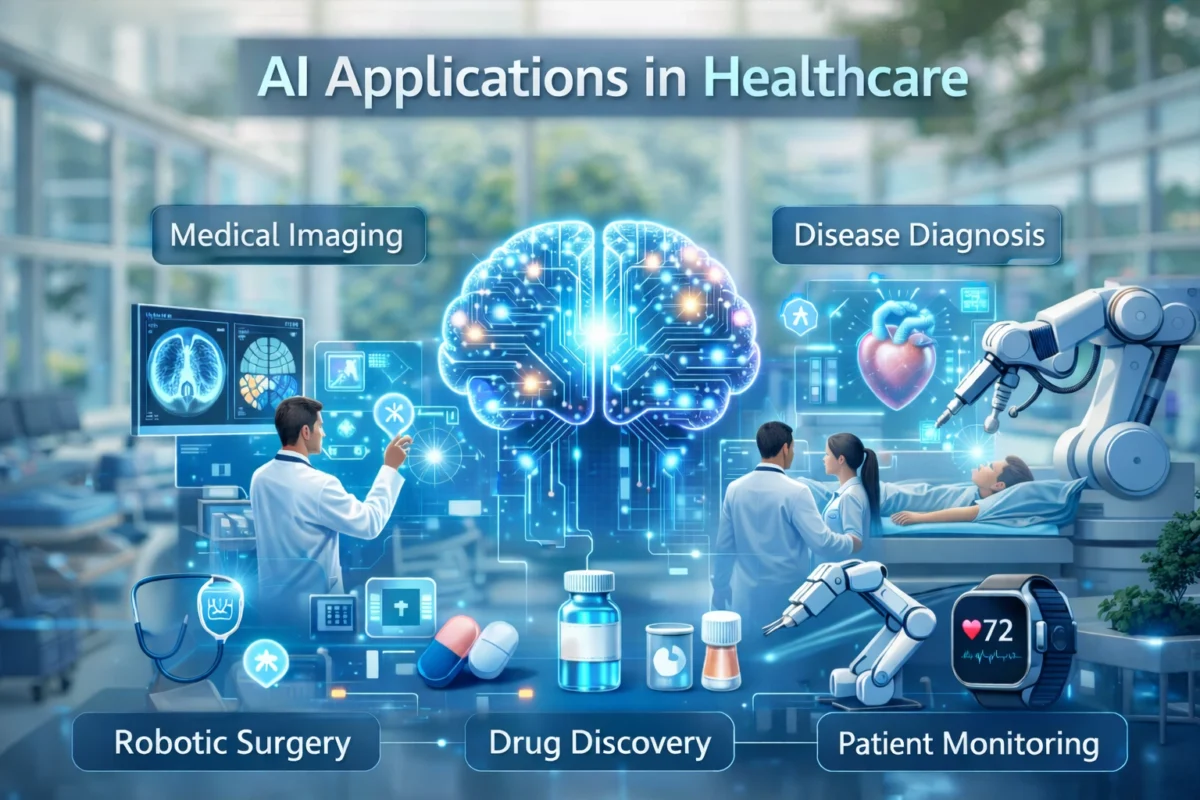
AI Applications in Healthcare
1. AI in Medical Imaging
Role of AI in Medical Imaging
Artificial Intelligence analyzes medical images to detect diseases more accurately and quickly, making it one of the most important applications of Artificial Intelligence in healthcare.
Key Uses
- X-ray image analysis
- MRI scan interpretation
- CT scan detection
- Ultrasound imaging
Benefits
- Early disease detection
- Faster diagnosis
- Improved accuracy in identifying abnormalities
Example
- Google Health AI
- Aidoc AI
2. AI in Disease Diagnosis
AI-Based Disease Detection
AI systems analyze patient data and symptoms to identify possible diseases, which is one of the key applications of Artificial Intelligence in healthcare.
How AI Helps Doctors
- Analysis of patient medical history
- Evaluation of laboratory reports
- Detection of symptom patterns
- Disease risk prediction
Advantages
- Faster diagnosis
- Reduced human errors
- Better clinical decision-making
Example
- IBM Watson Health
- Ada Health App
3. AI in Drug Discovery
AI in Medicine Development
Artificial Intelligence makes pharmaceutical research faster and more efficient, which is one of the important applications of Artificial Intelligence in healthcare.
AI Applications
- Chemical compound analysis
- Drug testing simulations
- Disease target identification
- Drug repurposing research
Benefits
- Faster discovery of new medicines
- Reduced research and development costs
- Improved effectiveness of drugs
Example
- Insilico Medicine
- DeepMind AlphaFold
4. AI in Robotic Surgery
AI-Assisted Surgical Systems
AI-powered robotic systems assist surgeons in performing complex surgical procedures, making robotic surgery one of the important applications.
Key Features
- High-precision surgical tools
- Advanced 3D visualization
- Robotic arm assistance during operations
Advantages
- Smaller surgical incisions
- Less blood loss during surgery
- Faster patient recovery
Example
The da Vinci Surgical System
5. AI in Remote Patient Monitoring
Continuous Health Monitoring
AI-powered wearable devices and sensors monitor patient health continuously, making remote patient monitoring one of the key applications of Artificial Intelligence in healthcare.
Monitoring Tools
- Smartwatches
- Fitness trackers
- Medical sensors
- Mobile health applications
Health Data Tracked
- Heart rate
- Blood pressure
- Sleep patterns
- Blood oxygen levels
Example
- Apple Watch
- Fitbit Health AI
6. AI in Personalized Medicine
Customized Treatment Plans
AI recommends treatments based on a patient’s genetic data and medical history, which is one of the important applications of Artificial Intelligence in healthcare.
AI Analysis Factors
- Genetic information
- Medical records
- Lifestyle habits
- Treatment response history
Benefits
- Personalized treatment plans
- Better recovery outcomes
- Reduced side effects from medications
Example
Tempus AI provides personalized cancer treatment recommendations based on patient data.
7. AI in Hospital Management
Smart Hospital Systems
AI helps optimize hospital operations and management systems, making hospital management one of the important applications of Artificial Intelligence in healthcare.
AI Management Functions
- Patient record management
- Appointment scheduling
- Staff planning and scheduling
- Resource allocation
Benefits
- Reduced waiting times for patients
- More efficient hospital workflows
- Improved healthcare services
Example
Qventus AI helps hospitals optimize patient flow and operational efficiency.
AI Healthcare Diagnosis Flowchart
Patient Data
↓
Data Collection
↓
AI Data Analysis
↓
Disease Prediction
↓
Doctor Review
↓
Treatment Plan
↓
Patient Care flow chart diagram
Real AI Tools Used in Hospitals
Hospitals around the world are already using advanced AI technologies to improve patient care and medical decision-making. These tools demonstrate the real applications of Artificial Intelligence in healthcare, helping doctors analyze medical data, perform accurate diagnoses and provide better treatment.
IBM Watson Health
Functions
- Medical data analysis
- Clinical decision support
- Treatment recommendations for doctors
- Processing large medical research datasets
IBM Watson Health helps healthcare professionals analyze complex medical information and supports them in making informed treatment decisions.
da Vinci Surgical System
Features
- Robotic surgical arms controlled by surgeons
- High-precision surgical procedures
- Enhanced 3D visualization during operations
- Minimally invasive surgery techniques
The da Vinci Surgical System is widely used in hospitals and represents one of the most advanced robotic surgery technologies in modern healthcare.
Aidoc AI
Radiology AI System
- CT scan analysis
- Early stroke detection
- Brain bleeding detection
- Prioritization of emergency cases for doctors
Aidoc AI assists radiologists by quickly analyzing medical imaging and identifying life-threatening conditions.
VisualDx
Diagnostic Support System
- Symptom analysis
- Large medical image database
- Disease identification support
- Clinical decision assistance for doctors
VisualDx helps doctors compare symptoms and medical images to identify possible diseases more accurately.
Nuance Dragon Medical One
AI Medical Documentation System
Functions
- Voice recognition for doctors
- Automatic medical note creation
- Electronic health record (EHR) integration
- Clinical documentation support
Nuance Dragon Medical One is an AI-powered voice recognition system that helps doctors record patient information quickly and accurately. It converts spoken medical notes into digital records, saving time and reducing administrative workload. This tool is widely used in hospitals and clinics as one of the practical applications of Artificial Intelligence in healthcare, improving efficiency and allowing doctors to focus more on patient care.
AI Healthcare Startup Opportunities
The AI healthcare sector provides many opportunities for new startups and innovations.
AI Symptom Checker
Features:
- Symptom input system
- Disease prediction
- Health risk alerts
- Doctor consultation suggestions
AI Medical Report Analyzer
Functions:
- Lab report upload
- Medical test analysis
- Simple health explanation
- Disease risk detection
AI Mental Health Chatbot
Capabilities:
- Emotional support
- Stress monitoring
- Anxiety management
- Mental health guidance
AI Chronic Disease Monitoring
Target diseases:
- Diabetes
- Heart disease
- Hypertension
- Chronic respiratory diseases
Benefits of AI in Healthcare
AI helps make healthcare systems more efficient and effective by improving diagnosis, treatment and hospital management.
Major benefits:
- Faster disease diagnosis
- Improved patient care
- Reduced medical errors
- Better treatment planning
- Increased hospital efficiency
Challenges of AI in Healthcare
There are also some challenges in implementing AI.
Major issues:
- Patient data privacy concerns
- Ethical issues in decision making
- High technology cost
- Need for trained professionals
Future of AI in Healthcare
Future healthcare systems will become more advanced with the integration of Artificial Intelligence, improving diagnosis, treatment and patient care.
Expected developments:
- Smart hospitals with automation
- AI powered diagnostic systems
- Predictive healthcare models
- Advanced robotic surgery
Conclusion
Artificial Intelligence is transforming healthcare by improving how diseases are diagnosed, treated and managed. Hospitals increasingly use AI technologies to analyze medical data, detect diseases earlier and support doctors in making accurate clinical decisions. The applications of Artificial Intelligence in healthcare include medical imaging, drug discovery, robotic surgery and remote patient monitoring. These technologies help reduce medical errors, improve treatment outcomes and enhance hospital efficiency. As AI continues to evolve, it will play an even greater role in making healthcare systems more efficient, accessible and reliable.
FAQs
1. What are the applications of Artificial Intelligence in healthcare?
The applications of Artificial Intelligence in healthcare include medical imaging, disease diagnosis, drug development, robotic surgery, remote patient monitoring and hospital management. These technologies help healthcare professionals analyze medical data quickly and support better clinical decisions.
2. How is Artificial Intelligence used in hospitals today?
Hospitals use Artificial Intelligence to analyze patient records, interpret medical images, support diagnosis, and manage hospital operations. AI tools also assist doctors in treatment planning and help improve the overall efficiency of healthcare services.
3. Why is Artificial Intelligence important in healthcare?
Artificial Intelligence is important because it improves diagnostic accuracy, reduces medical errors, and allows doctors to analyze large amounts of medical information quickly. This helps provide better patient care and faster treatment decisions.
4. What are the benefits of Artificial Intelligence in healthcare?
AI provides many benefits, including faster disease detection, personalized treatment plans, improved hospital management and continuous patient monitoring. These advantages make healthcare systems more efficient and accessible.
5. What is the future of Artificial Intelligence in healthcare?
The future of Artificial Intelligence in healthcare looks promising. AI technologies are expected to improve predictive diagnosis, develop new medicines, enhance robotic surgeries, and support doctors in delivering more precise and efficient healthcare services.
Call to Action
Interested in the future of technology and innovation? Explore more insightful articles on Writac to discover how artificial intelligence, emerging technologies and digital trends are shaping the world.