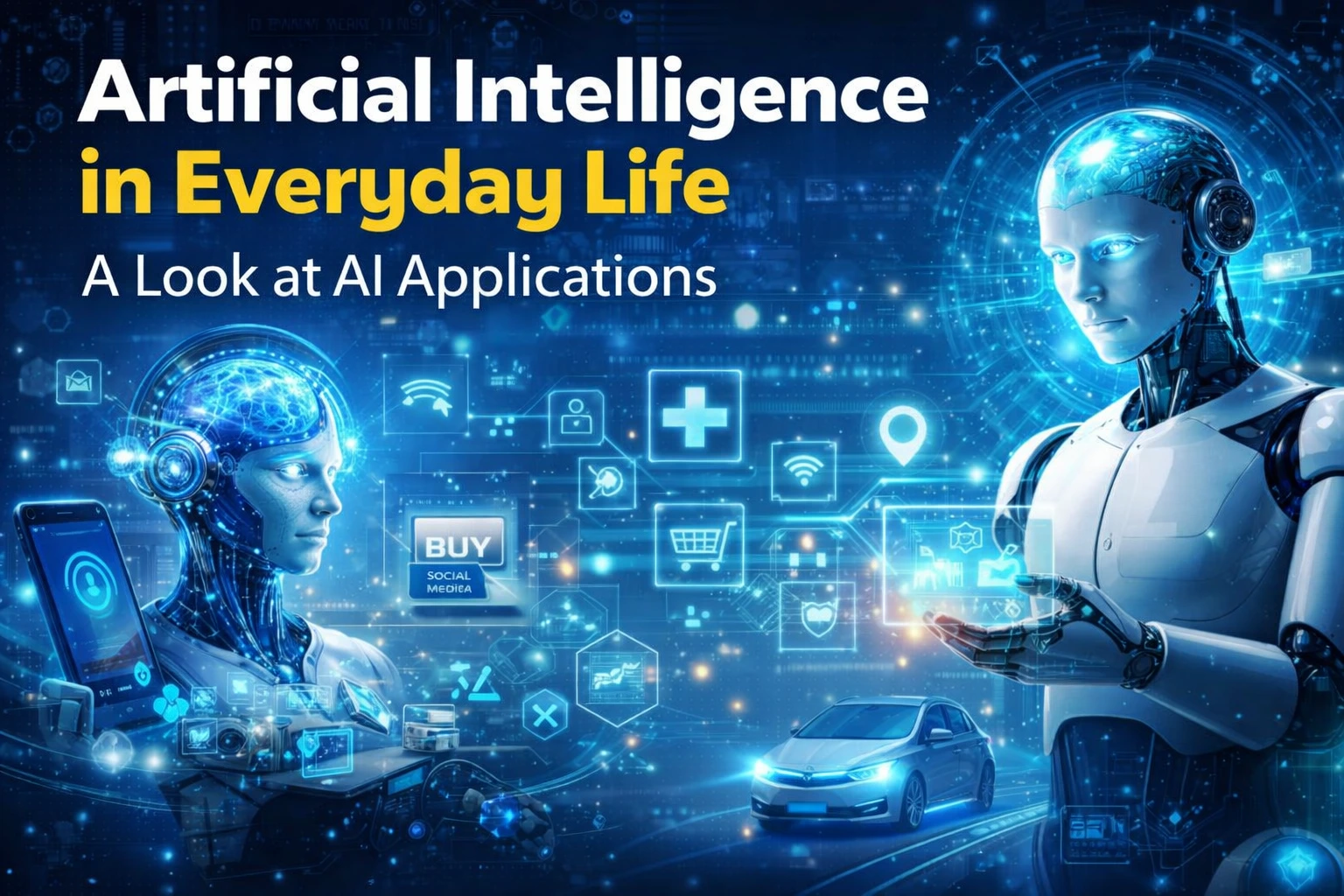

Have you ever taken a moment to reflect on just how much Artificial Intelligence in everyday life affects your daily activities, often without you even realizing it? AI is no longer a concept of the future, something you see in sci-fi films or in a lab. Instead, it is already quietly integrated into your online shopping, communication with others, travel, work, and even your health.
From recommendations to intelligent assistants and decision-making, AI is working in the background to make your life easier, faster, and more convenient. Most of the time, we are the ones benefiting from it without even realizing how much work it is saving us.
In this blog, we will discuss just how artificial intelligence in your everyday life is actually being used, with examples of how you are using it every day, and why this technology is changing the future at a pace that has never been seen before.
What Is Artificial Intelligence in Simple Words?
Artificial Intelligence refers to machines and software that can think, learn, and make decisions like humans. Instead of following fixed instructions, AI systems analyze data, recognize patterns, and improve over time.
In simple terms, AI helps machines:
- Learn from experience
- Understand language and images
- Make predictions and recommendations
AI in Everyday Life: Where Do We See It?
Artificial intelligence has become a silent partner in our daily routines. Let’s break down its most common applications.
AI in Smartphones and Personal Assistants
Smart Assistants That Understand You
Voice assistants like Siri, Google Assistant, and Alexa use AI to understand spoken commands, answer questions, and perform tasks.
AI helps these assistants:
- Recognize speech patterns
- Understand natural language
- Learn user preferences over time
From setting alarms to controlling smart homes, AI makes smartphones more intelligent and user-friendly.
AI in Social Media and Entertainment
Personalized Feeds and Recommendations
Ever noticed how social media platforms show content you actually like? That’s AI at work.
AI applications in social media:
- Recommend videos, reels, and posts
- Filter spam and harmful content
- Improve photo tagging and face recognition
Streaming platforms also use AI to suggest movies and shows based on your viewing history, keeping you engaged without endless searching.
AI in Online Shopping and E-Commerce
Smarter Shopping Experiences
Artificial intelligence has transformed online shopping into a personalized experience.
AI helps e-commerce platforms by:
- Recommending products you might like
- Predicting buying behavior
- Managing inventory and pricing
Chatbots powered by AI also provide instant customer support, answering queries 24/7 without human intervention.
AI in Healthcare and Wellness
Improving Diagnosis and Patient Care
AI plays a critical role in modern healthcare by supporting doctors and improving patient outcomes.
Common AI applications in healthcare include:
- Early disease detection through medical imaging
- Virtual health assistants for symptom checking
- Personalized treatment recommendations
AI doesn’t replace doctors, it enhances their ability to make faster and more accurate decisions.
AI in Transportation and Navigation
Making Travel Safer and Smarter
Navigation apps rely heavily on artificial intelligence to provide real-time traffic updates and route suggestions.
AI helps transportation by:
- Predicting traffic congestion
- Optimizing delivery routes
- Supporting self-driving vehicle technology
Even ride-hailing apps use AI to match drivers with passengers efficiently.
AI in Workplaces and Business Operations
Boosting Productivity and Decision-Making
AI has become a valuable tool in offices and businesses of all sizes.
In the workplace, AI is used for:
- Automating repetitive tasks
- Analyzing large datasets quickly
- Enhancing customer relationship management
By handling routine work, AI allows employees to focus on creativity, strategy, and problem-solving.
Benefits of Artificial Intelligence in Daily Life
Artificial intelligence offers several advantages that make life easier and more efficient:
- Saves time through automation
- Improves accuracy and decision-making
- Enhances personalization
- Increases productivity
- Supports innovation across industries
As AI continues to evolve, these benefits will only grow stronger.
Challenges and Ethical Considerations
Despite its advantages, AI also raises important concerns:
- Data privacy and security
- Job displacement due to automation
- Bias in AI decision-making
Responsible development and ethical use of AI are essential to ensure it benefits society as a whole.
Conclusion: The Future of AI in Everyday Life
Artificial intelligence is no longer a distant innovation, it is a powerful force shaping how we live, work, and interact with technology. From smartphones and shopping to healthcare and transportation, AI applications are improving efficiency, personalization, and convenience across all areas of life.
As AI continues to advance, understanding its role in everyday life becomes increasingly important. When used responsibly, artificial intelligence has the potential to enhance human capabilities and create a smarter, more connected world.
FAQs
1. Is artificial intelligence safe to use in daily life?
Yes, AI is generally safe when used responsibly. Most everyday AI applications are designed with user privacy and security in mind.
Do I need technical skills to use AI tools?
No. Most AI-powered tools are user-friendly and designed for non-technical users.
3. Can AI replace human jobs completely?
AI may automate certain tasks, but it also creates new job opportunities and supports human work rather than fully replacing it.
4. How does AI learn from users?
AI learns by analyzing data, user behavior, and patterns to improve accuracy and personalization over time.
5. Will AI continue to grow in everyday applications?
Absolutely. AI adoption is increasing rapidly and will become even more integrated into daily life in the coming years.