

Nowadays, bloggers, digital marketers, small business owners and people who want to earn through Google all have the same question: Is AI-generated content approved? Many people use tools such as Chat GPT, Gemini, and Claude.
Content written using AI Can rank on Google
Most people actually make mistakes when it comes to writing long responses. Google doesn’t reward content just because it’s written by a human, and it doesn’t punish content created with AI either. What really matters to Google is how helpful, high-quality, and trustworthy the content is. In this, I’ll explain Google’s official statements, how AI-generated content is ranked in reality, and how you can safely use AI for SEO without any issues.
What Google Really Thinks About AI Content
There’s a big myth going around that Google hates AI content. That’s simply not true.
Google has clearly stated that content is judged by quality, not by how it is created. Whether a human writes it, AI helps write it, or both work together, the rules stay the same.
Google’s focus is on:
- Helpful content
- Original insights
- Accurate information
- Good user experience
So when people ask about Google AI content policy, the key thing to understand is this:
- Google is against spam, not against AI.
If AI is used to mass-produce low-value articles just to rank keywords, that’s a problem. If AI is used as a tool to create useful, well-edited content, that’s absolutely fine.
Can AI Content Rank on Google If It’s High Quality?
Yes, it already does.
I’ve personally seen AI-assisted articles ranking on:
- Page one for competitive keywords
- Featured snippets
- “People Also Ask” boxes
The reason? Those articles were not published straight out of an AI tool. They were reviewed, edited, improved, and aligned with search intent.
AI content ranks when:
- It answers the user’s question clearly
- It adds value beyond basic definitions
- It’s written for people, not algorithms
- It’s checked for accuracy and clarity
In other words, AI content SEO works when AI is used as an assistant, not a replacement.
Real-World Example: AI Content Ranking on Page One
For example: a UK-based blogging website published an article targeting a long-tail keyword related to “email marketing tools for small businesses”.
The first draft was created using AI, but it wasn’t published as-is. The blogger:
- Rewrote the introduction in their own words
- Added UK spelling and local context
- Included a short comparison table
- Updated pricing and tool features manually
Within a few weeks, the article:
- Ranked on page one
- Appeared in People Also Ask
- Continued ranking even after Google updates
This shows that AI-assisted content can rank on Google when it’s edited, useful, and written for real users.
When AI Content Fails to Rank
Let’s be honest, a lot of AI content doesn’t rank. But that’s not because it’s AI. It’s because I’m lazy.
AI content usually fails when:
- The same generic content is published everywhere
- No human editing is done
- There’s no clear point of view
- The article doesn’t match user intent
- Keywords are stuffed unnaturally
- The content feels empty or rushed
Google’s Helpful Content system is designed to spot content that exists only to rank, not to help.
Example: Why Some AI Content Never Ranks
On the other hand, I have also seen AI content fail badly.
One site published dozens of AI-written articles without any editing. The content:
- Repeated the same phrases again and again
- Had no clear opinion or insight
- Was written only to target keywords
Despite publishing frequently, the site:
- Didn’t rank for competitive terms
- Lost impressions after Helpful Content updates
- Saw very low time on page
The issue wasn’t AI, it was low effort and no human involvement.
Pros and Cons of AI Generated content
Pros
- Faster content production
- Helpful for outlines and research
- Good for improving clarity and structure
- Useful for scaling content teams
- Cost-effective for small businesses
Cons
- Can sound generic without editing
- May include outdated or incorrect facts
- Lacks real-world experience by default
- Easy to overuse and publish low-quality pages
AI is powerful, but it still needs human judgement.
Common Myths About AI-Generated Content Ranking
Myth 1: Google automatically penalizes AI content
False. Google penalizes spam, not AI.
Myth 2: AI content can never rank for competitive keywords
False. Many high-ranking pages today use AI assistance.
Myth 3: You must hide the fact that AI was used
Wrong mindset. Focus on quality, not hiding tools.
Myth 4: Human content is always better
Not necessarily. Poor human content performs worse than well-edited AI content.
Best Practices to Make AI Content Rank on Google
If you want AI-generated content ranking safely in 2025, follow these proven best practices.
1. Always Edit and Personalise
Never publish raw AI output. Add:
- Your own insights
- Examples from experience
- UK-specific context where relevant
2. Match Search Intent
Ask yourself:
- Is the user looking for information?
- A comparison?
- A solution?
Your content should clearly solve the user’s problem.
3. Follow E-E-A-T Principles
Google values:
- Experience
- Expertise
- Authority
- Trust
Add credibility by:
- Explaining why something works
- Mentioning practical use cases
- Avoiding vague claims
4. Use AI for Structure, Not Shortcuts
AI is excellent for:
- Outlines
- FAQs
- Rewriting for clarity
But the final voice should sound human.
5. Keep It Natural
- Repetitive phrases
- Over-optimized keywords
- Robotic sentence patterns
If it sounds unnatural when read aloud, fix it.
Practical Example: Editing AI Content the Right Way
Let’s say you’re writing a blog post using AI.
Instead of publishing the draft directly, you:
- Rewrite the opening paragraph to sound more natural
- Add one or two examples from your own experience
- Remove unnecessary filler sentences
- Simplify complex explanations
Is AI Content Safe for Google AdSense?
Yes, AI content is safe for AdSense as long as it follows quality guidelines.
- Original
- Helpful
- Free from copyright issues
- Substantial
Many AdSense-approved sites today use AI as part of their workflow.
The Future of AI Content and SEO
AI is not going away. Google knows this. Instead of fighting AI, Google is refining its systems to reward genuinely helpful content, regardless of how it’s created.
In the future, successful bloggers will be those who:
- Combine AI efficiency with human insight
- Focus on readers, not shortcuts
- Build trust over time
Mini Case Study
A solo UK blogger running an informational website wanted to publish more content without sacrificing quality.
They used AI to:
- Create outlines
- Suggest headings
- Draft basic explanations
But every article was:
- Manually reviewed
- Edited for clarity
- Improved with examples and FAQs
Results After 3 Months:
- Multiple articles ranking on page one
- Improved user engagement
- Google AdSense approval without issues
Google rewarded helpful content , not the writing method.
Final Verdict
Google doesn’t care whether content is written by a human, assisted by AI, or created using a mix of both. What Google actually rewards is content that is useful, original, accurate, and written with real users in mind.
Many websites ranking today are already using AI, but readers don’t notice because the content feels human, helpful, and trustworthy. That’s exactly what Google wants to rank.
The mistake most people make is treating AI as a shortcut. In reality, AI works best as a supporting tool, helping with structure, research, and clarity, while humans add experience, judgement, and authenticity.
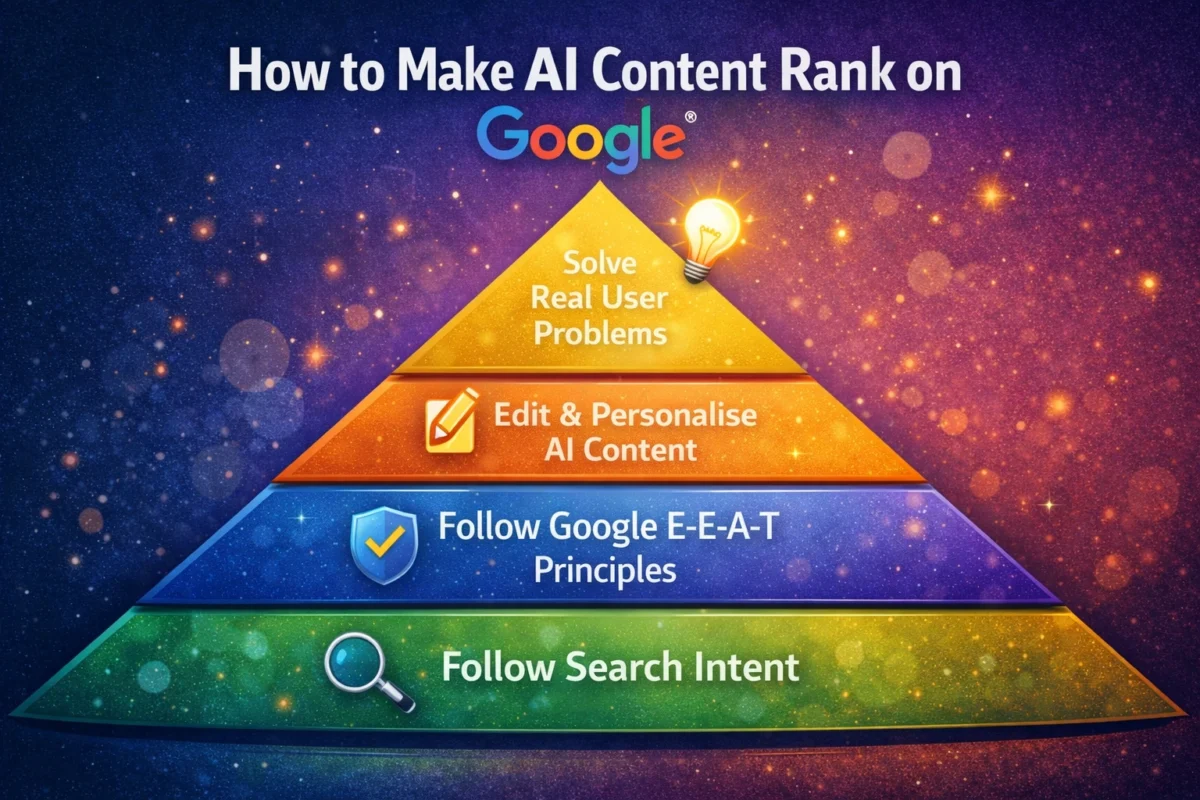
- Solving real user problems
- Editing and personalizing AI-assisted content
- Following Google’s Helpful Content and E-E-A-T principles
The future of content isn’t AI vs humans , it’s AI + humans working together. When you get that balance right, rankings follow naturally.
FAQs
1.Can AI content rank on Google in 2026?
Yes, AI content can rank in 2026 if it meets Google’s quality and helpful content standards.
2.Does Google detect AI-written content?
Google focuses on content quality, not detection. Poor content fails regardless of who or what writes it.
3.Is AI content bad for SEO?
No. Bad content is bad for SEO. AI content can perform very well when properly edited.
4.Can I use AI for blog posts and still get AdSense approval?
Yes, as long as your content is original, useful, and follows AdSense policies.
5.Should UK websites avoid AI content?
No. UK websites can safely use AI if the content is accurate, relevant, and helpful to users.
𝐀𝐈 𝐜𝐨𝐧𝐭𝐞𝐧𝐭 𝐭𝐡𝐚𝐭 𝐫𝐚𝐧𝐤𝐬 𝐢𝐬 𝐧𝐨𝐭 𝐚𝐛𝐨𝐮𝐭 𝐬𝐡𝐨𝐫𝐭𝐜𝐮𝐭𝐬, 𝐢𝐭’𝐬 𝐚𝐛𝐨𝐮𝐭 𝐬𝐭𝐫𝐚𝐭𝐞𝐠𝐲.
At Writac, we combine AI efficiency with human expertise to create Google-safe, high-quality content that builds authority and drives organic traffic.