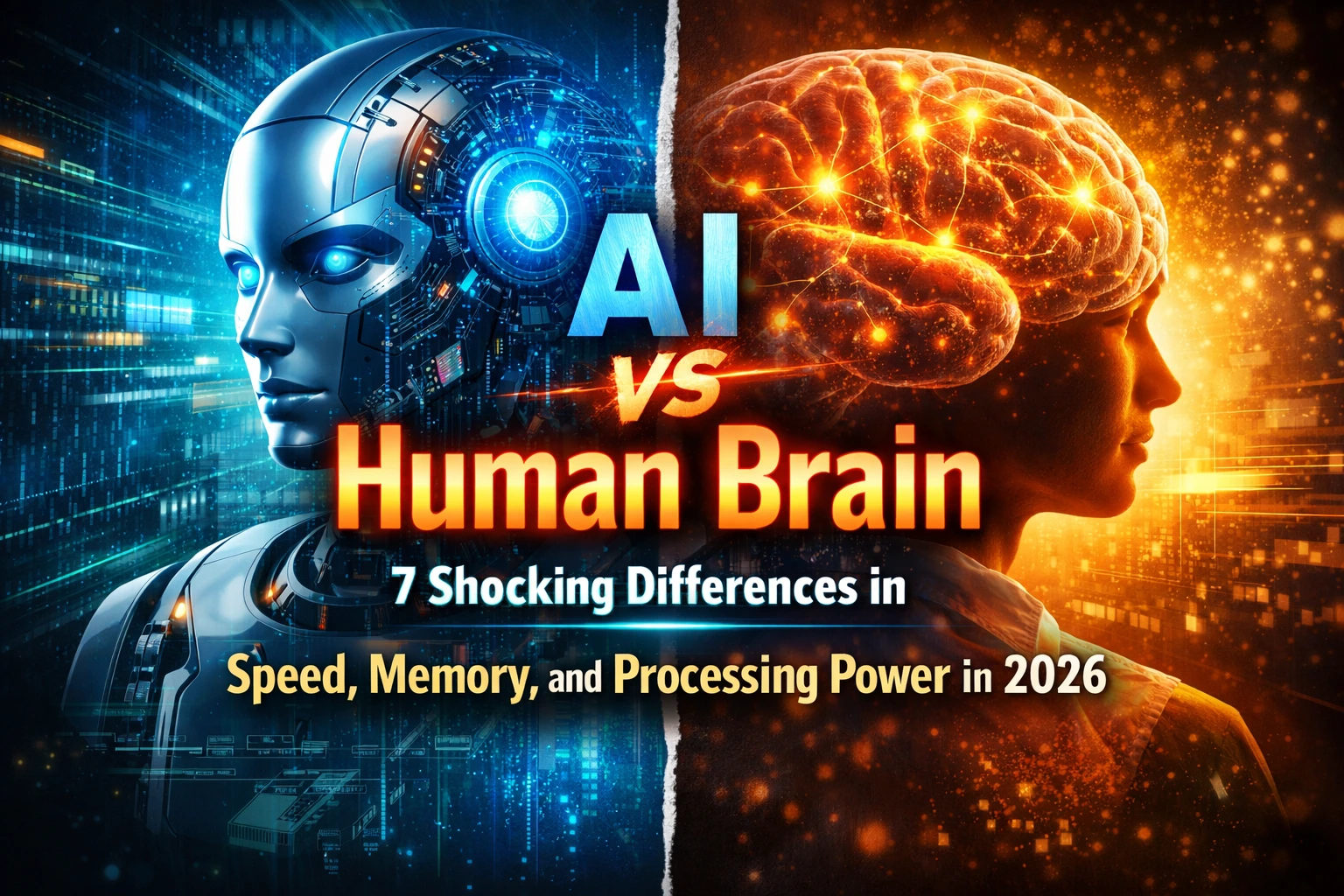
AI vs Human Brain: 7 Shocking Differences in Speed, Memory and Processing Power in 2026

Technology is no longer just evolving, it’s accelerating at a breathtaking pace. In 2026, artificial intelligence is shaping the world around us. From diagnosing diseases in seconds to powering smart devices and transforming creative industries, AI has moved from science fiction to everyday reality.
But as machines grow smarter, a powerful question demands attention:
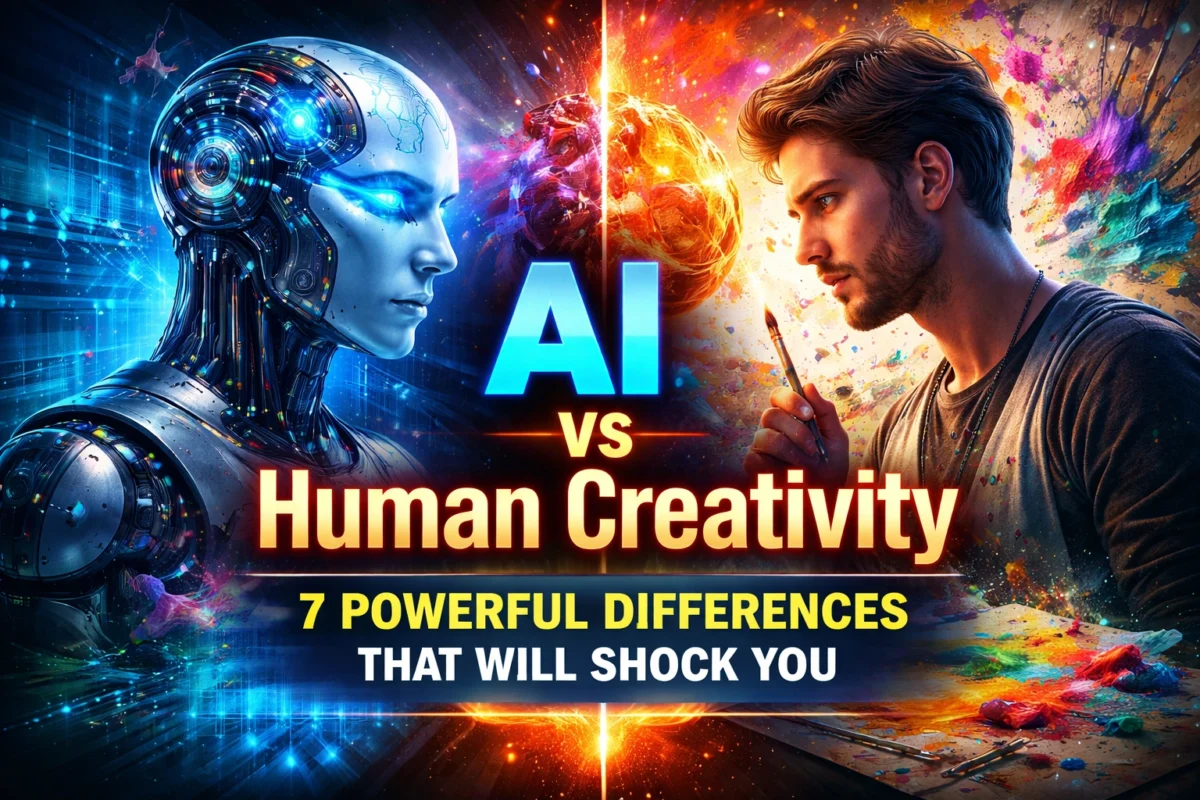
In the battle of AI vs Human Brain, who truly leads?
Is artificial intelligence faster? Absolutely.
Is it more precise? Often.
But is it truly more intelligent than the human mind?
The human brain remains one of the most extraordinary systems ever known, capable of imagination, emotion, ethical reasoning, and groundbreaking innovation. While AI can process trillions of calculations per second, the human brain interprets meaning, context, and feeling in ways technology still struggles to replicate.
So what happens when we compare them side by side?
In this in-depth guide, we dive deep into the AI vs Human Brain debate and uncover seven shocking differences in speed, memory, processing power, creativity, and intelligence that will completely change how you see the future of technology.
Let’s explore what truly separates artificial intelligence from human intelligence.
1. Processing Speed in AI vs Human Brain
Machines Calculate Faster, Humans Understand Deeper
Comparison
| Feature | AI | Human Brain |
| Processing Speed | Trillions of calculations per second | Slower neural signal transmission |
| Technology Base | Silicon-based processors | Billions of biological neurons |
| Strength | Handles large-scale data instantly | Interprets meaning and context |
| Best For | Financial modeling, analytics, pattern recognition | Emotional understanding and complex reasoning |
| Calculation Ability | Extremely fast and precise | Slower but deeply interpretive |
| Context Understanding | Limited contextual awareness | Strong interpretation of tone and emotion |
| Overall Advantage | Speed and efficiency | Meaning and comprehension |
2. Memory Capacity: Storage in AI vs Human Brain
Perfect Recall vs Emotional Memory
The human brain is estimated to store up to 2.5 petabytes of information, but it does not function like a hard drive. Human memory is emotional and reconstructive. human memory have 2 types short or long, We forget details, reshape experiences.
| Feature | Perfect Recall (AI) | Emotional Memory (Human Brain) |
| Accuracy | Stores information exactly as it is | May forget or change details over time |
| Storage | Can store massive amounts of data | Limited but meaningful storage |
| Retrieval | Retrieves data instantly and precisely | Influenced by emotions and context |
| Consistency | Always consistent and unchanged | Can vary based on mood or experience |
| Emotion | No emotional connection | Strong emotional attachment to memories |
| Learning Impact | Uses stored data for pattern analysis | Uses memories to shape behavior and decisions |
| Flexibility | Fixed and factual | Adaptive and personal |
3. Learning Ability in AI vs Human Brain
When discussing AI vs Human Brain, learning methods differ significantly.
AI learning;
- Massive datasets
- Repetitive training
- Pattern recognition
Humans learning:
- Observation
- Emotion
- Social interaction
- Experience
- Knowledge
4. Creativity: Innovation in AI vs Human Brain
Creativity is one of the most debated aspects of AI vs Human Brain comparison.
AI can generate:
- Articles
- Artwork
- Music
- Code
Case Study: Creativity in Action – A Marketing Campaign Launch
A fashion brand planned to launch a new clothing line aimed at young adults. The company wanted something fresh, creative and emotionally engaging.
Role of AI
The marketing team used AI tools to:
- Analyze data and social media trends
- Identify colors and styles
- Slogans/Taglines
- ADs
AI provided useful insights based on patterns and numbers.
Role of Humans
The creative team then stepped in.
- Developed a unique brand story
- Designed visuals that reflected real emotions
- Created a campaign message that connected with people’s lifestyle and identity
The final slogan wasn’t chosen just because of data, it was chosen because it felt right.
Result
The campaign was successful. Sales increased, and customers connected strongly with the brand message.
5. Emotional Intelligence in AI vs Human Brain
Emotional intelligence highlights a clear divide in AI vs Human Brain capabilities.
AI can analyze facial expressions and voice tones. It can simulate empathy in conversations.
However, AI does not feel. Humans experience joy, fear, compassion, and love. These emotions influence decisions, ethics, and relationships.
6. Energy Efficiency: Power Use in AI vs Human Brain
One of the most shocking differences is energy consumption.
The human brain operates on approximately 20 watts of power.
Despite its complexity, it remains highly efficient.
AI systems require vast computational resources.
Data centers consume massive electricity to train and operate advanced models.
From an efficiency standpoint, the comparison strongly favors the human mind.
7. Accuracy and Consistency in AI vs Human
AI performs repetitive tasks with remarkable consistency. It does not get tired, distracted, or emotionally influenced.
The difference between ai and human ,here is clear:
- AI delivers consistency.
- Humans deliver adaptability.
Comparison Table
| Feature | AI | Human Brain |
| Processing Speed | Extremely Fast | Contextual Processing |
| Memory | Unlimited Storage | Emotional Recall |
| Learning | Data-Driven | Experience-Based |
| Creativity | Pattern-Based | Original Thinking |
| Emotions | Simulated | Genuine |
| Energy Use | High | Highly Efficient |
| Consistency | Precise | Adaptable |
The Future of AI vs Human Brain Collaboration
The real question is not superiority, but how humans and intelligent systems can work together.
Doctors use advanced technology for faster and more accurate diagnoses.
Engineers rely on powerful simulations to design and test innovations.
Businesses leverage data analytics for smarter decision-making.
Machines process vast data quickly, while humans contribute creativity and ethical judgment.
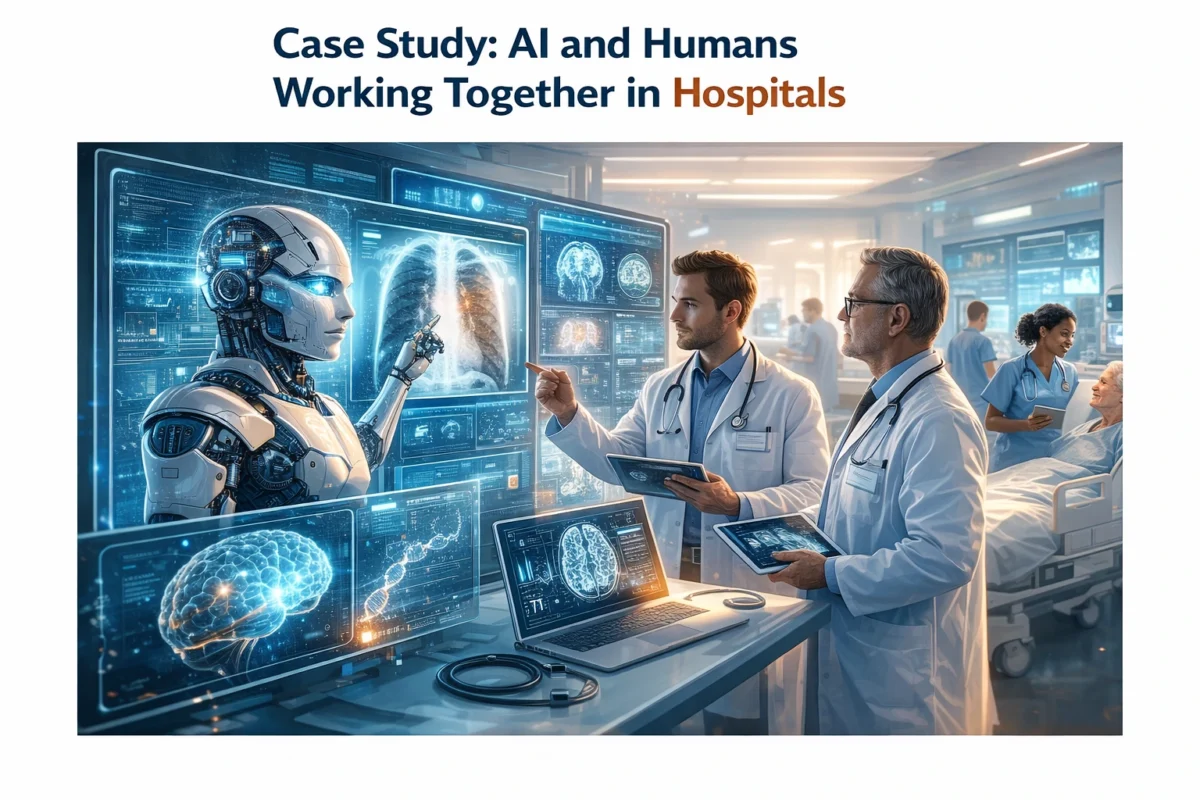
Case Study: AI and Humans Working Together in Hospitals
How AI Helps Doctors
In 2026, many hospitals will use AI to help doctors find diseases faster.
The Problem
Doctors look at many medical reports and scans every day. Sometimes they get tired or miss small details.
The AI Help
AI systems check X-rays, MRI scans and test results very quickly. They can find unusual signs in just seconds.
The Doctor’s Role
AI gives suggestions, but doctors make the final decision. Doctors use their experience, understanding and care for patients before giving treatment.
The Result
- Faster diagnosis
- Fewer mistakes
- Better treatment
- Happier and safer patients
Conclusion
When we really think about it, the AI vs Human Brain comparison isn’t about choosing a winner. Yes, technology is fast, accurate, and incredibly powerful. But the human brain carries something deeper, emotion, imagination, intuition, and lived experience. In 2026, artificial intelligence can support us in ways we once only imagined. Still, it doesn’t feel, dream or reflect the way we do. That’s what makes us different.
The future isn’t about replacing people with machines. It’s about using technology wisely, letting it handle complex tasks while humans continue to think, create, care, and lead. When both work together, the possibilities become far greater than either could achieve alone.
Frequently Asked Questions
What is the main difference between AI and the human brain?
The main difference is how they “think.” AI works with data, codes, and patterns. It processes information logically and quickly. The human brain, however, doesn’t just process data, it understands feelings, context, and experiences. We connect ideas with emotions and meaning.
Is AI more powerful than the human brain?
It depends on what kind of power we’re talking about. If it’s speed and handling huge amounts of information, AI clearly wins. But when it comes to creativity, empathy, and flexible thinking, humans still lead. Both are powerful. just in different ways.
Can AI replace the human brain?
Not really. AI can help us, support us, and even outperform us in certain tasks. But it doesn’t have self-awareness or real emotions. It doesn’t “live” experiences the way humans do. So full replacement? Very unlikely.
How fast is AI compared to the human brain?
AI is extremely fast. It can perform trillions of calculations in seconds. The human brain is slower in raw calculations, but it understands tone, meaning, and emotion, things that speed alone can’t fully capture.
Which is more energy-efficient: AI or the human brain?
This one surprises many people. The human brain runs on about 20 watts of power, like a small bulb. AI systems, especially large ones, use much more electricity. So in terms of energy efficiency, the human brain is impressive.
Call To Action
At Writac, we dive deep into technology, innovation, and the evolving relationship between AI and human intelligence. If you found this article on AI vs Human Brain insightful, stay connected with us for more in-depth content on artificial intelligence, digital trends, and the future of technology.