AI vs Human Creativity: 7 Powerful Differences That Will Shock You

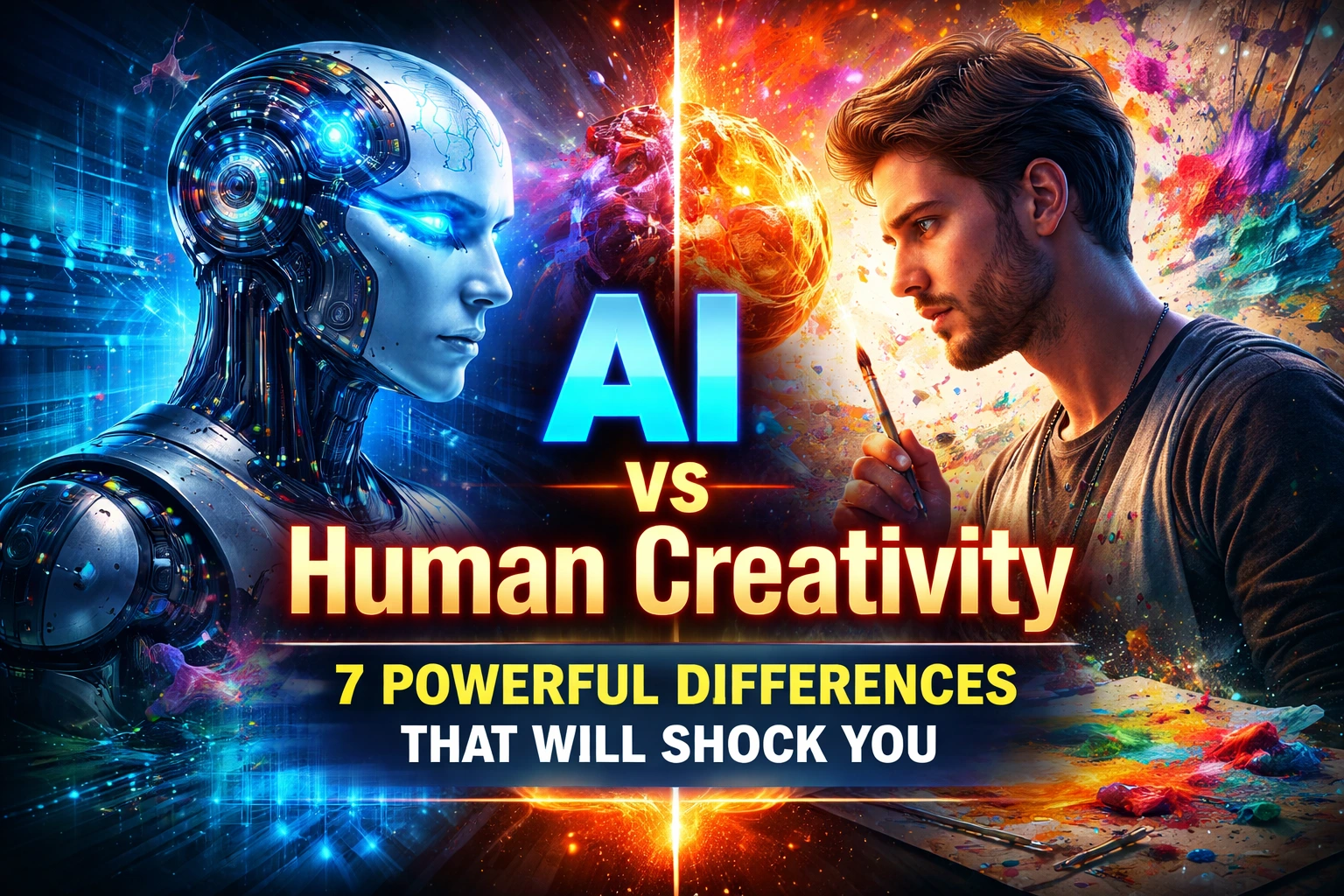
Artificial Intelligence is rapidly transforming how we create, think and innovate. From generating art to writing content, machines are now capable of producing outputs that were once considered uniquely human. This evolution has sparked an important debate, AI vs Human Creativity. Can machines truly match human imagination or is creativity something that only humans possess?
As AI tools become more advanced, understanding the differences between machine-generated content and human creativity becomes essential. In this blog, we’ll explore seven powerful differences, real-world examples and what the future holds.
What is Creativity?
Creativity is the ability to generate original ideas, solve problems and express thoughts in unique ways. It is deeply connected to emotions, experiences and imagination.
Types of Creativity:
- Artistic creativity (painting, music, writing)
- Analytical creativity (problem-solving, innovation)
- Emotional creativity (storytelling, expression)
Humans use creativity to express their inner world, while machines rely on external data.
Understanding AI Creativity
AI creativity is powered by machine learning algorithms and large datasets. It analyzes patterns and produces outputs based on what it has learned.
Unlike humans, AI does not experience emotions or consciousness. Instead, it predicts what should come next based on probabilities.
AI vs Human Creativity: 7 Powerful Differences
1. Emotion vs Data
The most significant difference in AI vs Human Creativity is emotion.
Human creativity is driven by feelings such as love, joy, pain and inspiration. These emotions shape the way humans create art, music and stories.
AI, on the other hand, works with data. It does not feel emotions, it only simulates them based on patterns.
Example:
A human writes a poem from personal heartbreak, while AI generates a poem based on learned structures.
2. Originality vs Imitation
When discussing AI vs Human Creativity, originality stands out.
Humans can create something entirely new, often inspired by their unique perspectives. AI, however, generates content by combining existing data.
Example:
AI can create artwork in the style of famous artists, but it cannot truly invent a completely new artistic movement.
3. Conscious Thinking vs Programming
Another key difference in AI vs Human Creativity is awareness.
Humans create with intention and purpose. They are aware of what they are doing and why.
AI operates based on programming and algorithms. It does not have self-awareness or intention.
Example:
A writer carefully chooses words to convey meaning, while AI selects words based on probability.
4. Experience vs Training Data
Experience plays a major role in AI vs Human Creativity.
Human creativity is shaped by life experiences, culture and personal memories. Every individual brings a unique perspective.
AI relies on training data. It learns from existing information but does not have real-life experiences.
Example:
A filmmaker creates a story based on real-life events, while AI generates a script from data patterns.
5. Flexibility vs Limitation
Flexibility is another major difference in AI vs Human Creativity.
Humans can think outside the box, break rules and experiment with new ideas.
AI is limited by its programming and training data. It operates within predefined boundaries.
Example:
Humans can invent new art styles, while AI tends to replicate or remix existing ones.
6. Meaning vs Output
In the comparison of AI vs Human Creativity, meaning is crucial.
Human creations often carry deep emotional and personal meaning. They reflect thoughts, beliefs and experiences.
AI-generated content may look impressive but often lacks deeper meaning.
Example:
A human song reflects real emotions, while AI-generated music may sound good but lacks emotional depth.
7. Innovation vs Optimization
The final difference in AI vs Human Creativity is innovation.
Humans are innovators, they create entirely new ideas and concepts.
AI is an optimizer, it improves existing systems and processes.
Example:
Humans invent technologies, while AI enhances their efficiency.
Comparison Table: AI vs Human Creativity
| Feature | Human Creativity | AI Creativity |
| Emotion | Present | Absent |
| Originality | High | Limited |
| Learning | Experience-based | Data-based |
| Flexibility | High | Moderate |
| Meaning | Deep | Surface-level |
| Innovation | Strong | Limited |
| Awareness | Conscious | None |
Benefits of AI Creativity
AI creativity is not without its advantages. In fact, it offers several benefits:
- Faster content generation
- Increased productivity
- Cost efficiency
- Accessibility for beginners
Businesses use AI tools to create content at scale, saving time and resources.
Limitations of AI Creativity
Despite its benefits, AI has clear limitations:
- Lack of emotional understanding
- Limited originality
- Dependence on data
- Ethical concerns
AI-generated content may feel repetitive or lack authenticity.
Real-World Examples of AI Creativity
AI creativity is already being used in various industries:
Key Applications:
- Art and design
- Music production
- Content creation
- Film and animation
Example:
AI tools can generate logos, write blogs and create videos within minutes.
The Future of AI and Human Creativity
The future is not about replacing humans, it’s about collaboration.
In the evolving discussion of AI vs Human Creativity, both will play important roles. AI will enhance efficiency, while humans will provide originality and emotional depth.
What to Expect:
- Human-AI collaboration
- Smarter creative tools
- New creative industries
Artists and creators will use AI as a tool to amplify their creativity.
FAQs
1. Can AI truly be creative?
AI can generate content, but it lacks emotions and true originality.
2. Is AI better than humans in creativity?
AI is faster, but humans are more creative and emotional.
3. Can AI replace human creativity?
AI can assist, but it cannot fully replace human creativity.
4. What are examples of AI creativity?
AI-generated art, music and writing are common examples.
5. What is the future of creativity?
The future lies in collaboration between humans and AI.
Conclusion
The debate of AI vs Human Creativity highlights the strengths and limitations of both. While AI excels in speed and efficiency, human creativity remains unmatched in originality, emotion, and meaning.
Rather than competing, the real opportunity lies in combining both, using AI as a tool to enhance human imagination and innovation.
Call o Action
Ready to explore the future of creativity and AI? Visit Writac to discover powerful insights on technology and innovation. Stay updated, share knowledge and be part of the future of creativity.